Skip to content

Facebook ads that find your next customer.

Your next customers are on Facebook every day. The right ads reach them for less than you think. The wrong ones just donate to Meta.

  • Feed
  • Reels
  • Stories
  • Marketplace
  • Groups
  • Video

Part of Meta Ads management at Aesthetic.

Worth it, with conditions

Why Facebook ads still work.

Facebook ads put your business in front of people before they go looking for it. You pay for their attention, and the quality of your ad decides whether that attention turns into sales or scrolls straight past.

What it is

Your ads, across every feed.

Your ads shown in Facebook's feed, Reels, Stories and Marketplace. You control the offer, the ad itself and who you're trying to reach. Meta decides who actually sees it, guided by the sales your account reports back.
When it works

Broad appeal, visual proof.

Products and offers a stranger can understand mid-scroll: ecommerce, local services, anything that shows well in a photo or a 15-second video. Fresh ads and accurate sales tracking are what keep it working.

When it's the wrong tool

People already searching.

Someone typing "emergency electrician" belongs to Google, not the feed. So do tiny niche audiences, and businesses with one ad and no appetite for testing. Facebook interrupts; it doesn't answer.

What makes Facebook expensive

Boring ads pay full price.

Facebook charges every business a different price for the same audience, and the discount goes to ads people actually want to watch. Dull ads pay more for less, and the dashboard never says that's why.

  • Every ad wears outThe same people see it again and again, attention drops, and each sale costs a little more every week while the ad stays exactly the same.
  • Targeting like it's 2019Stacking detailed targeting options used to be the craft. Since Apple's privacy changes it mostly shrinks your audience and raises your costs, chasing people Facebook could find cheaper on its own.
  • A pixel nobody has checkedThe pixel is how Facebook learns what's selling. When it reports the wrong numbers, Facebook chases the wrong customers, and nobody notices until the money's gone.
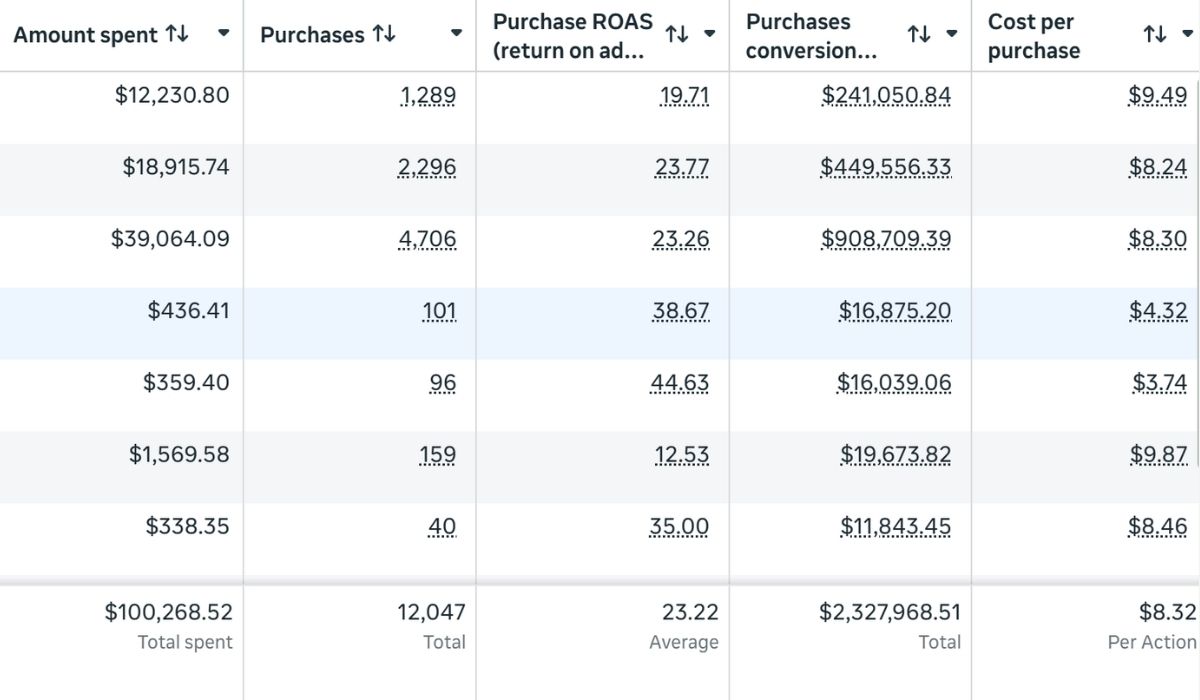
Live Facebook ads account managed by Aesthetic showing over two point three million dollars in tracked revenue at 23 times return on ad spend
  • $2.3MRevenue from $100K in spend
  • 23.22xAverage return on ad spend
  • $8.32Cost per purchase, 12,047 sales

Twelve months of Facebook ads on an ecommerce account run by Aesthetic, reported straight from Ads Manager.

What working together looks like

How your Facebook ads get managed.

Four stages, run on a weekly rhythm. The same system behind the campaign in the screenshot above, applied to your account.

  1. Tracking before spend Your pixel and tracking checked against real sales before anything spends. Facebook can only find customers it can see, so the seeing gets fixed first.
  2. Ads built to be tested Ad ideas pulled from how your customers actually talk, image and video made to be tested rather than admired, and ad copy that follows the playbook.
  3. Launch broad, learn fast Wide audiences instead of guesswork targeting, budgets sized for a fair test, and the rules for switching things off agreed up front. Meta's delivery engine rewards a clean setup.
  4. Scale what survives Fresh ads rotated in weekly before the old ones wear out, frequency watched closely, and budget moved toward whatever proves itself. Reporting checks Facebook's numbers against your actual sales.

Work with a Wollongong Meta Ads team

Facebook ads management vs retainer.

Two ways to work with a Facebook ads agency, depending on how much control and consistency you want.

What do Facebook ads cost?

Facebook ads management

Best for short-term campaigns or testing a new offer. A flexible, project-based approach where you only pay for the work delivered.

  • Flexible, project-based setup
  • Great for one-off campaigns or seasonal pushes
  • Pay for the work delivered, no ongoing commitments
  • Useful when you want to stay close to the account day to day
Compare pricing
What do Facebook ads cost in Australia?

There's no rate card. You bid for attention at auction, pay mostly per impression, and the price moves with competition and season. The useful number is your own: work backwards from average order value and margin to the price a sale can pay.

The calculator on this page does it in a minute, and management fees sit openly on the pricing page.

Do Facebook ads still work, or has everyone left?

The exodus is a story told mostly on other platforms. The buying audience, especially 25 to 55 with money to spend, is still scrolling daily, and the auction still sells their attention cheaper than almost anywhere.

What stopped working is lazy targeting and stale ads. Keep the ads fresh and the tracking accurate, and Facebook still delivers.

Should I boost posts or use Ads Manager?

A boost buys attention on a post; a campaign buys an outcome. Boosting skips the objectives, exclusions and conversion optimisation that make ads accountable, which is why it feels easy and reports nothing useful.

Boost to warm up an organic winner occasionally. Spend real money through Ads Manager only.

What happened to targeting after iOS 14?

Apple's privacy changes cut off much of the data advertisers relied on, and the era of stacking 14 targeting options ended with it. What replaced it works differently: broad audiences, with the creative doing the targeting and your own customer data feeding the algorithm.

Accounts still micro-targeting like it's 2019 pay more to reach fewer of the right people.

Do I need the pixel, the Conversions API, or both?

Both. The pixel watches from the browser, where ad blockers and privacy settings hide a share of your sales; the Conversions API reports from your website's server and fills the gaps. Run together and deduplicated, they give the algorithm a truer picture of what's selling.

Facebook optimises exactly as well as the data you give it. This is the least glamorous, highest-return fix in most accounts.

What creative actually works on Facebook now?

Creative that looks like it belongs in the feed: real footage, a hook in the first second, proof over polish, captions for the sound-off majority. The ad that survives is the one people choose not to scroll past.

Volume matters as much as quality: several angles tested beats one polished ad defended. The ad copy guide covers the writing half.

How big should my audience be?

Bigger than feels comfortable. Since the privacy changes, Facebook finds buyers faster in a big pool than inside a narrow slice, and tight audiences mostly buy you higher costs and faster fatigue.

The control that still matters is exclusion: existing customers and irrelevant regions out, then let delivery breathe.

How long before Facebook ads pay for themselves?

Expect a learning period measured in weeks, not days: the account needs conversion volume to optimise against, and the creative needs a test cycle or two before the winners emerge.

Judge the trajectory at 30 days and the verdict at 90. Anyone promising profit in week one is reading from a different script.

Why was my ad account restricted?

Usually automation, not malice. Common triggers: health or income claims, before-and-after imagery, payment hiccups, sudden spend spikes, or a new account behaving like a hacked one.

Prevention is compliant creative and steady behaviour; recovery is appeals through Business Manager, patience, and not creating a second account in a panic, which makes everything worse.

Can Facebook ads do lead generation?

Very well, with one trade to manage. Instant forms fill fast because they're frictionless, and the form that's easiest to fill is also the easiest to fill with junk. Landing pages filter harder and convert warmer.

Either way, lead outcomes have to flow back into the account, or the algorithm optimises for form-fillers instead of customers.

Should I just run Advantage+ and let Meta handle it?

Advantage+ Shopping is strong for online stores with steady sales and accurate tracking, and it deserves a slice of those budgets. What it isn't is a strategy: controls are thin, reporting is opaque, and it will happily claim credit for sales your brand earned elsewhere.

Treat it as one campaign type on the roster, never the whole team.

Do I need an Instagram account to run Facebook ads?

No. One campaign can serve across both platforms from Ads Manager, and Meta can show your ads on Instagram using just your Facebook Page. Placements can also be trimmed to Facebook only.

Whether you should trim them is a different question, covered on the Instagram ads page.

Why do my results die after two weeks?

Creative fatigue, almost every time. The audience your budget can reach has seen the ad, frequency climbs, and the auction starts charging you for diminishing attention.

The fix is new ads on a schedule, not a bigger budget. Fresh angles keep results steady and costs flat. Meta's frequency control changed the maths here, and it's worth understanding.

Free ROAS calculator

Your real return, not the dashboard's.

ROAS without margin is a vanity number. This calculator works out what your ads return after the cost of what you sell, for Google, Meta or any paid channel.

$

What you pay the ad platform each month.

$

The revenue those ads brought in.

%

The share of each sale you keep after the cost of the product or service.

Your ROAS

3.0x

Profitable. Every ad dollar makes money after costs.

Return needed to break even

2.2x

Profit left each month

$1,050

Kept per $1 spent on ads

$0.35

ROAS return on ad spend

Revenue divided by ad spend. A 3x ROAS means every dollar of ads brought back three dollars of revenue. It says nothing about profit until margin enters the picture.

Breakeven ROAS the floor

One divided by your gross margin. At a 45% margin you need 2.2x just to cover the cost of goods and the ads. Anything below this line is a loss wearing a revenue costume.

Profit on ads the real number

What's left after paying for the products and the ads. Revenue is money moved; this is money kept, and it's the number your bidding targets should answer to.

The calculator runs in your browser. Your numbers aren't stored or sent anywhere.

Ready when you are

Get more out of every ad dollar.

A free 30-minute call with the strategist who'd run your account. Bring your numbers, ask anything, and leave with a clear next step, whether or not that step is Aesthetic.