Google finished its November core update on 25 November, Sydney time, and announced the next one about an hour later. That December update is the first core update Google has ever announced before it started rolling out.
If you’re trying to work out what happened to your website in October, though, you’re looking at the wrong update. The September spam update ran into early October, and rankings moved again later that month without any update Google will put its name to.
So before you pay anyone to rewrite a website that was bringing in perfectly good enquiries a fortnight ago, I’d want three answers. Which page lost ground, what were people searching for and did fewer of them actually call or buy? Below is each Google algorithm update from spring 2026, in Sydney time, with what it was for and how to tell whether your site took a hit.
The short version
Google’s spring updates, untangled.
- September’s spam update finished on 8 October. It applied in Australia, and Google didn’t say which tactic it was after.
- October moved without a named update. Trackers picked up shifts from mid-month. Google hasn’t confirmed anything.
- November’s core update is done. Give it a full week of data after 25 November before you judge it.
- December’s update is announced but not live. Google says it’s about longer, more complex searches and personalised results.
- Judge a drop by enquiries and sales. A page that slipped a few spots but still brings in work can wait a week.
Which Google updates actually happened?
Here’s the timeline I’d use for an Australian business. The dates below are in Sydney time. Google’s ranking update history runs on US Pacific time, which is why some announcements look like they landed a day earlier.
| When (Sydney time) | What happened | What it tells you |
|---|---|---|
| 25 September to 8 October | September 2026 spam update | Google improved how it detects search spam, worldwide. It didn’t name a tactic or an industry. |
| Mid to late October | Ranking movement reported by the industry | Trackers and site owners saw results shift. Google didn’t confirm a cause. |
| 11 to 25 November | November 2026 core update | A broad change to how Google ranks pages. The rollout is complete. |
| Announced 25 November | December 2026 core update | Scheduled for December. Google hadn’t given a start date as of 26 November. |
What was the September spam update looking for?
Google already runs automated systems that spot attempts to game its results. A spam update makes those systems better at the job. The September announcement didn’t name a tactic or an industry, so anyone telling you exactly what it targeted is guessing.
Google’s guide to spam updates explains how the process works, including the part nobody enjoys reading: recovery can take months while its systems relearn your site.
Should a local business worry about its suburb pages?
Say you’re a roofer covering Wollongong, Corrimal and Thirroul. Someone in Thirroul wants to know two things: do you come that far north, and have you done a job like theirs? A page showing a local reroof, the material you used and the area you service gives them a reason to keep reading. There’s more on building that kind of page in our SEO guide for tradies.
Now picture dozens of copies of that page where only the suburb name changes. Each one promises local service, but the visitor has to click through somewhere else to find anything useful. That’s the kind of setup Google describes as doorway abuse. If your suburb pages genuinely help someone choose you, keep them. If the heading is the only local detail on the page, that’s where I’d start.

Through the September to October update I saw a widespread decline across businesses with templated location and service pages. They shared one layout and the same paragraphs, with a suburb or service name swapped in and very little else changed. Google never said that’s what the update went after, so I won’t claim it did. But if your site has a stack of pages that only differ by their heading, check those before you touch anything else.
Links follow the same logic. Paying for a batch of links purely to climb Google is listed in its spam policies. A supplier listing you as a stockist because you actually sell their product is a different thing, because it helps a customer find you. Our guide to link building that works goes deeper on earning the good kind.
Why did rankings move again in late October?
Search Engine Roundtable reported spikes in ranking movement around 16 October, 20 and 21 October, 24 October and 27 October, based on industry chatter and third-party tracking tools. Google lists no October update in its ranking update history.
That doesn’t make the movement imaginary. Google says it also runs smaller core updates it never announces, so an unconfirmed wobble can still be real. You just can’t put a name on it.
Say your traffic first dipped on 25 October. The September rollout had finished and November’s hadn’t started, so I’d look hard at the affected pages before writing a cause into a client report. For a retailer, did a popular product sell out? For a wedding venue, did last October’s open day create a spike you’re now comparing against? Either question gives you something you can actually check.
What did the November core update change?
A core update is a broad change to how Google sorts its unpaid results. Your page can stay exactly as you wrote it and still drop, because Google now rates another result as more useful for that particular search. A drop on its own doesn’t tell you that your business broke a rule.
Google’s explanation of core updates is fairly direct about that. It’s also where the advice to wait a full week after the rollout comes from, which matters for the checks further down.
Did any real websites move?
Yes. Between 13 and 24 November, SISTRIX recorded a roughly 78% increase in UK search visibility for Harvey Norman’s UK website. That figure measures where the site appeared across the searches SISTRIX tracks. It tells you nothing about Australian rankings, how many people visited the UK site or how many sofas it sold.
The more useful lesson is in the same report. The Guardian first showed up among the sites that had lost visibility, but when SISTRIX looked further back, the decline was already under way before the update started. A short date range made an existing trend look like a fresh hit, and your own reports can do exactly the same thing. Have a read of the SISTRIX November analysis for the UK data.
What should you do about the December update?
As of 26 November, Google had named two priorities for December. It wants to get better at finding relevant pages for longer, more complex questions. It also wants to improve personalised results for people who have personalisation switched on, which means the results you see when you search for your own business may not match what a customer sees.
Here’s the change I’d make regardless of when December lands. Take one question customers ask before they buy or book. Open the page you’d send them to. Could they make the decision from what’s actually on it?
Four Australian pages that already answer the question
Bunnings does this well with paint. Someone buying paint needs to know how many litres to take home, so the Bunnings paint calculator asks for the room’s dimensions and how many doors and windows it has, then works out the paint for two coats. A local painter could answer the equivalent quoting question by spelling out which measurements and photos to send.
Wedding venues can borrow from Wollongong Botanic Garden. A couple weighing it up will want to know whether their guests can stand under cover if it rains. The council’s private event booking form says the Rose Garden Rotunda shelters a wedding party of around 15 and explains the marquee option. For a couple with 60 guests, that changes the decision. If you run a venue, put your wet-weather capacity where people first look at your ceremony spaces.
Commercial kitchen suppliers have an easy one here. A cafe owner might have room for an underbench dishwasher right up until someone opens the door. Norris lists its Madison IM5 at 615 mm deep and 1,008 mm with the door open. Put both measurements beside the product photo and you’ve answered the buyer’s question before the tape measure comes out.
Furniture and homewares retailers can take a cue from IKEA. A family shopping for a beige sofa may care more about getting a spill out than the name of the fabric. IKEA Australia says the Gunnared beige cover for its KIVIK three-seat sofa comes off and can go in the washing machine at up to 40 degrees. If you sell clothing or homewares, the care instructions can be the detail that makes the sale.
These pages show what a useful answer looks like today. How they rank after December is still an open question.
How to check whether your own website was affected
You need two sources. Google Search Console shows the searches that brought people to your site. Your analytics, booking system or store shows the enquiries and orders those pages actually produced. Here’s the order I’d work through it.
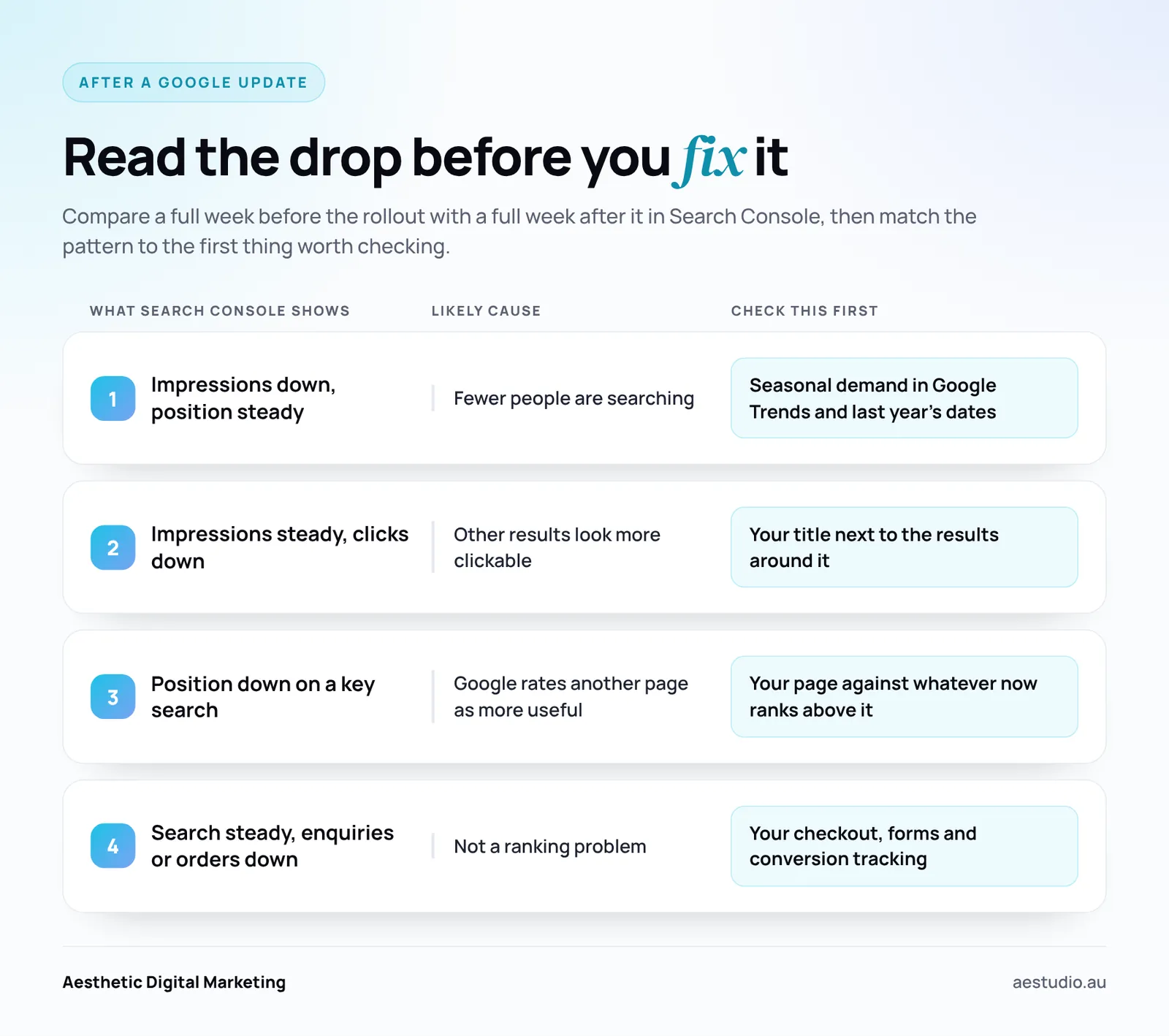
- Compare two complete weeks. In Search Console, open Performance, then Search results. Choose Web, filter to Australia if that’s your market and select Compare in the date filter. For November, compare 3 to 9 November with 25 November to 1 December once all seven days are in. Search Console’s daily data uses Pacific time, so those dates keep the entire rollout out of the comparison.
- Find the page and search term that moved. In the Pages tab, sort by the biggest drop in clicks. Select a page, open Queries and compare clicks, impressions (how often it appeared) and average position. A caterer losing clicks on its own business name has a very different problem from one losing visibility for “corporate lunch catering Sydney”.
- Check demand and anything you changed. If impressions fell while the position for the same term held steady, check seasonal demand in Google Trends. If impressions held up but clicks fell, look at the other results on the page and how your title reads next to them. Retailers should also line up this year’s Black Friday dates, stock and promotions against last year’s. Google’s guide to diagnosing traffic drops walks through both patterns.
- Match the change to a business outcome. If an important service page keeps losing visibility and enquiries, look at the page and at whatever now ranks above it. If search traffic is steady but orders have disappeared, test the checkout and confirm purchases are still being recorded. A blog rewrite won’t fix a broken checkout.
If your rank tracker and Search Console disagree, our explainer on Semrush ranking data covers what each one measures. For a small shift on a page that’s still bringing in work, I’d give it another week before changing the copy.
Rankings check
Which page stopped bringing in enquiries?
Send me the page and the date you first noticed a change. That’s enough to start a useful conversation about what to check.
Questions business owners are asking
Does a ranking drop mean Google penalised my website?
Not on its own. Check the Manual actions report in Search Console. If a Google reviewer has applied a manual action, you’ll see the reason there. A clear report still leaves other possibilities, including automated ranking changes, technical issues and changes in demand.
Is it still OK to use AI to help write content?
Yes. Google says AI can help with research and structure. Producing lots of pages mainly to manipulate rankings can break its spam policies, however you produce them. If you’re a builder, an AI draft still needs your actual inclusions, project details and photos before it can answer a customer’s question about your work. Google’s guidance on using AI for content spells it out.
Do these updates affect Google Ads or Google Maps?
These announcements are about unpaid search rankings. If your ad leads fell, check Google Ads separately. If you’ve lost calls from your Maps listing, look at your Business Profile performance instead. Each one deserves its own investigation, and if it’s Maps, our Google Business Profile service is where I’d start.
Do I need longer blog posts for December?
No. Google’s announcement refers to the longer questions people type. Your answer can be a sentence, a product specification or a photo with a clear caption. A cafe owner asking how deep a dishwasher is with the door open needs one measurement.
When should I act if my traffic dropped?
Straight away if the site’s down, a booking form fails or an important page has disappeared. To assess the November core update itself, give Search Console at least a full week of complete data after the rollout. If a commercially important page shows a sustained drop, review that page and its search terms first.
How quickly can rankings recover after changes?
Google says some improvements can show an effect within days and others can take several months. There’s no guaranteed recovery date. Record what you changed and when, then keep watching the affected page, its main searches and the enquiries or sales it brings in.