
For most small businesses, the email software costs less than a phone plan. The real cost is the time it takes to do email well, and the real return depends on whether your automated flows are actually set up.
Below is what each part costs right now, with current platform prices, plus how to work out whether your email is paying for itself.
The short version
Most of the cost isn’t the software.
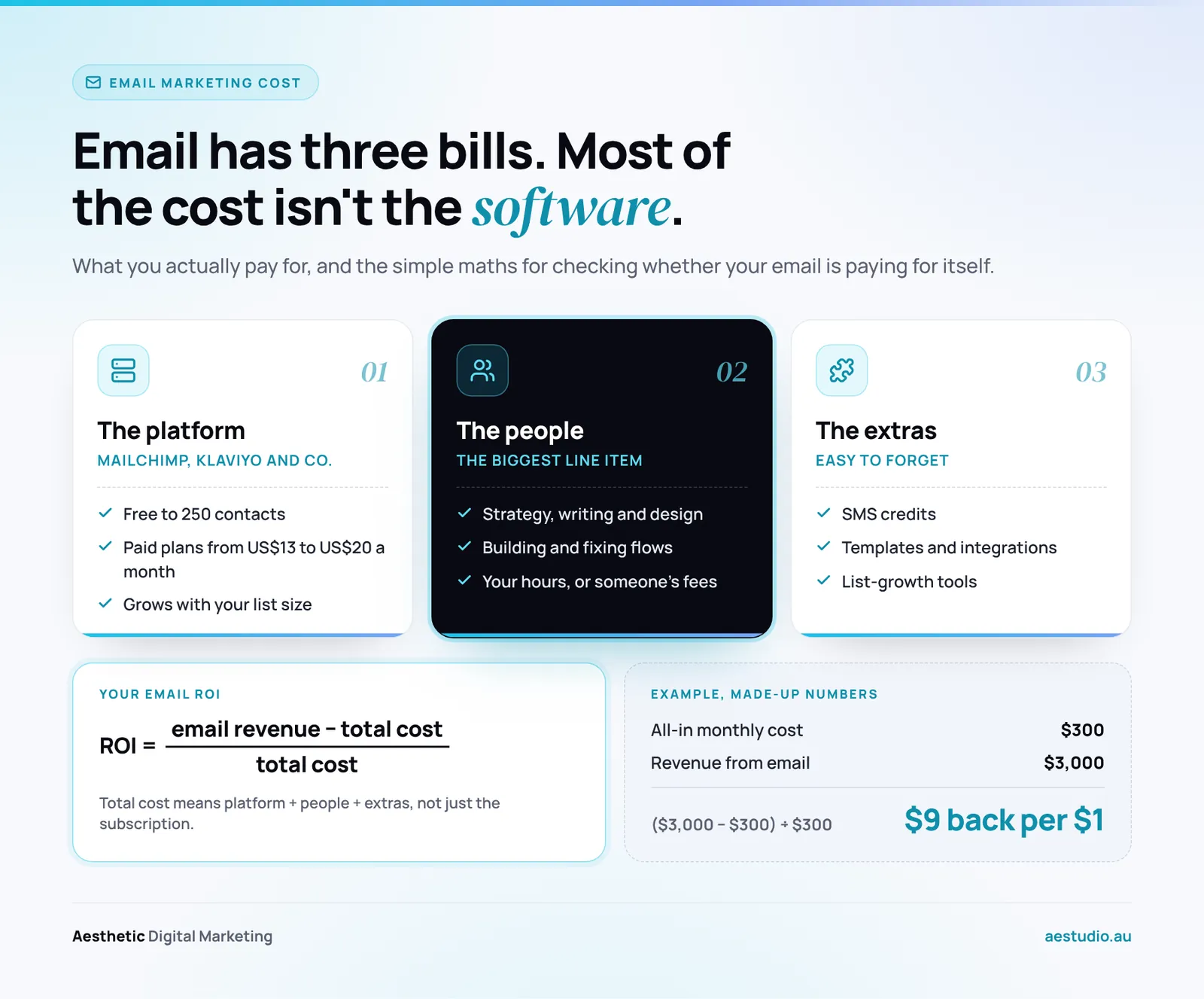
- The software is cheap to start. Mailchimp and Klaviyo are both free up to 250 contacts, and their paid plans start at US$13 and US$20 a month.
- Your list size sets the bill. Both platforms charge by how many people you store, so clearing out dead subscribers lowers what you pay.
- Time is the biggest line item. Strategy, writing, design, flows and reporting cost more than any subscription, whether you pay in hours or in fees.
- The famous $36 return comes from a survey. In Litmus’s latest data, about two in three marketers report between $10 and $50 back for every $1.
- Flows decide the return. Welcome, abandoned cart and post-purchase emails earn while you sleep. In my experience, a monthly newsletter on its own rarely justifies the spend.
The three costs of email marketing
When people ask what email marketing costs, they usually mean the software. That’s only one of three bills.
- The platform. Mailchimp, Klaviyo or similar. A monthly fee that grows with your list.
- The people. Someone has to plan, write, design, build the automations and read the reports. That’s your time, a freelancer, an agency or a hire.
- The extras. Add-ons like SMS credits, paid templates, integrations and the odd tool to grow your list.
Most businesses budget for the first and forget the second. Then the newsletter quietly stops after three months because nobody had time to write it, and the last thing your list heard from you was a Christmas special from two years ago.
What email marketing software costs in 2026
The two platforms I get asked about most are Mailchimp and Klaviyo. Both start free, and both charge more as your list grows.
Mailchimp is free for up to 250 contacts and 500 sends a month. Paid plans start at US$13 a month (Essentials), US$20 (Standard) and US$350 (Premium), on the smallest list size, then climb as you add contacts. Those are the prices on Mailchimp’s pricing page.
Klaviyo is free for up to 250 active profiles and 500 emails a month. The email plan starts at US$20 a month for 500 active profiles, per Klaviyo’s Australian pricing page. As a guide to how it climbs, Email Tool Tester’s breakdown puts it at about US$30 a month for 1,000 profiles, US$100 for 5,000 and US$150 for 10,000.
Two things catch Australian businesses out:
- The prices are in US dollars. Both platforms show USD on their Australian pages, so what lands on your card moves with the exchange rate.
- Prices change often. Treat these as the shape of it, and check the live page before you set a budget.
If you’re choosing between the two, our Klaviyo vs Mailchimp comparison covers which one suits which business. For the wider field, there’s a rundown of the best email platforms by business size.
Why your email bill grows even when your sales don’t
Email platforms charge for the people you store, whether or not they ever buy. That means a list full of people who stopped opening a year ago costs you real money every month.
The rules differ slightly by platform:
- Klaviyo bills on active profiles, meaning anyone it can still email. Unsubscribed and suppressed profiles don’t count.
- Mailchimp bills on your peak contact total for each billing period. Archived contacts don’t count, but archiving mid-month won’t lower a peak you’ve already hit.
So a regular clean-out is the cheapest saving in email. Remove or archive people who haven’t opened in months, after one last “still want to hear from us?” email. You pay less, and your deliverability usually improves too, because inbox providers notice when nobody opens. Our complete guide to email marketing covers deliverability in more detail.
What the people cost (the bigger bill)
Here’s the part that never shows up on a pricing page. A working email programme needs someone to:
- plan what goes out and to whom
- write and design each email
- build and maintain the automated flows
- segment the list so people get relevant emails
- check the reports and fix what isn’t working
There are four ways to cover that. Each one costs something different, and the cheapest on paper isn’t always the cheapest in practice.
| Option | What you pay | What you’re really buying | Watch out for |
|---|---|---|---|
| Do it yourself | Platform fees, plus your own hours | Full control, and nobody knows your customers better than you | It’s the first job to slip in a busy month |
| Freelancer | An hourly rate or a fee per email | Writing and design capacity for your campaigns | Strategy and flows are often outside the brief |
| Agency | A setup fee, a monthly retainer, or both | Strategy, flows, design, reporting and someone accountable for results | Paying a retainer for two newsletters a month when you needed flows built once |
| In-house hire | A salary, plus 12% super, plus software and training | A person who lives and breathes your brand every day | Only makes sense when email earns enough to keep someone busy full-time |
Freelance and agency rates vary a lot with scope, so compare what’s included rather than the headline number. On the in-house option, the super guarantee has been 12% since 1 July 2025, so build that into any salary comparison.

One client came to us wanting email marketing and nothing else, to sell a paid offer worth $6,000 per person. A single welcome email wasn’t going to cut it. We built a properly elaborate flow: separate automations for people signing up at different stages of the funnel, then branches that sent each person down a different route depending on what they did. By the end the flow map looked like a train network. Two months in, the offer had sold out. That’s the kind of return worth paying for, and it came from the flows, not from a monthly newsletter.
What email marketing actually returns
You’ve probably seen the claim that email returns $36 for every $1 spent. Our own email guide quotes it too, and it’s a fair headline. It comes from Litmus, an email testing company that regularly surveys marketers about their results.
But it’s worth knowing what’s underneath it. In Litmus’s 2025 State of Email data, based on nearly 500 marketers worldwide, the answers were spread out:
- 35% reported between $10 and $36 back for every $1
- 30% reported between $36 and $50
- 5% reported more than $50
So about two in three land somewhere between $10 and $50. That’s still a strong return for most businesses. Just treat it as a range of what marketers report, rather than a guarantee or a controlled test.
Where you land depends mostly on three things: whether your flows are running, how healthy your list is and whether people already want what you sell. For one skincare client, Intoxicate Skin, automated flows, cheeky campaigns and SMS drops lifted email revenue by 247%, and email now drives nearly a quarter of their revenue. Email is great at turning existing interest into sales, so if people aren’t asking for what you sell yet, fix that first.
How to work out your own email ROI
Forget the industry averages for a second. The only return that matters is yours, and the maths is simple:
Email ROI = (revenue from email minus total email cost) divided by total email cost
The trap is the word “total”. Count the platform, the add-ons and the time, not just the subscription.
Here’s how it works, with made-up numbers. Say you spend $300 a month all-in, covering software and the hours it takes. Your platform reports $3,000 in email revenue. That’s ($3,000 minus $300) divided by $300, which is 9. In other words, $9 back for every $1.
One caution. Email platforms are very generous when they mark their own homework. If someone opens an email and buys a few days later, the platform counts that sale, even if they were always going to buy. So look at the trend in your total sales too, not just the email dashboard. My piece on why every platform reports different numbers explains why.
Free email audit
Find out where your email is leaking revenue.
You’ll get a recorded walkthrough of your flows, deliverability and list, with the leaks and what to fix first. It’s normally valued at $400.
How to keep email costs down without hurting the return
- Start on a free or entry plan. Upgrade when a feature will clearly earn its keep, not because the higher tier looks more serious.
- Clean the list every quarter. It lowers the bill and helps your emails reach the inbox.
- Build flows before campaigns. Set up welcome, abandoned cart and post-purchase first. Our guide to the five email flows every Shopify store needs walks through each one.
- Stick to one platform. Paying for two tools that both half-work is common and expensive.
- Hold off on SMS. Get email working first, then add text messages if the numbers justify the credits.
- Reuse a template. A clean, consistent design beats a fresh build for every send, and costs far less.
- Send fewer, more relevant emails. Timing matters less than relevance. The studies on the best time to send email disagree for a reason.
When paying for help is worth it (and when it isn’t)
Getting help usually pays off when:
- you have steady website traffic or sales but no automated flows
- your list is growing and nobody is doing anything with it
- email keeps falling off your to-do list
- you’re paying for a platform but only using it to send the odd newsletter
It’s usually too early when:
- you have no list yet and no way to collect emails on your site
- you’re still working out what sells
- you’d be paying a retainer to email a few dozen people
In those cases, spend the money upstream first, on a website that captures leads and a reason for people to sign up. Once there’s a list worth working, that’s the time to get the flows built.
Frequently asked questions
How much does email marketing cost per month for a small business?
The software can be free for very small lists, and paid plans start around US$13 to US$20 a month. The bigger cost is time. Whether you write and build the emails yourself or pay someone to, that usually outweighs the subscription.
Is Mailchimp or Klaviyo cheaper?
Mailchimp is cheaper to start, with paid plans from US$13 a month against Klaviyo’s US$20. Klaviyo can cost more as your list grows, but it’s built for ecommerce and shows you the revenue each flow makes. Our Klaviyo vs Mailchimp comparison covers which suits which business.
What is a good ROI for email marketing?
In Litmus’s 2025 survey, about two in three marketers reported between $10 and $50 back for every $1 spent. The often-quoted $36 sits in the middle of that. Your own ROI depends on your flows, your list and your product, so measure it rather than assume it.
Do I pay for unsubscribed contacts?
It depends on the platform. Klaviyo only bills for active profiles, so unsubscribed and suppressed people don’t count. Mailchimp bills on your peak contact total, and archived contacts don’t count, so archiving people you no longer email can lower your bill.
Should I hire an agency or do email marketing myself?
If you have the time and a small list, doing it yourself on a free or entry plan is a fine start. Paying for help makes sense once you have traffic or sales but no flows running, or when email keeps slipping off your list. Many businesses get the best value from having the flows built properly once, then running the regular emails themselves.