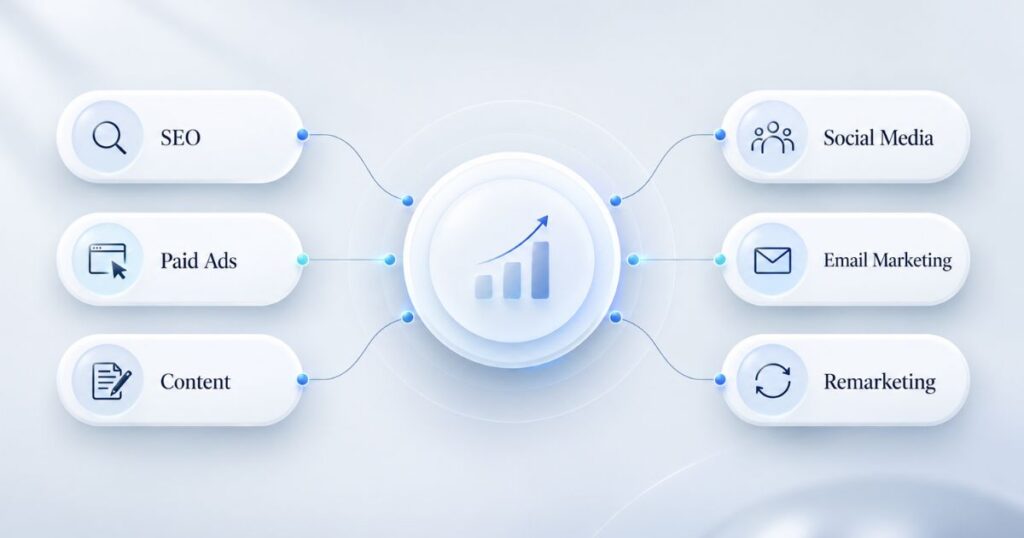
Ask ten businesses for their digital marketing strategy and nine will show you a list of tactics. We’re doing SEO, we’ve got ads running, we post on Instagram. That’s not a strategy, that’s a to-do list with a budget attached.
A real strategy is smaller and harder than that. It’s the set of decisions that tell you what to do and, more importantly, what to ignore. A strategy isn’t a list of tactics. It’s the choice about which tactics you’re deliberately not doing. Get those decisions right and the tactics almost pick themselves.
The good news is it fits on one page. After years of building these for clients, I’ve never needed forty slides to say something true. This is the one-page version: what actually belongs in a digital marketing strategy, why one channel beats five, and the numbers that tell you it’s working. If you’d rather someone ran the whole thing, that’s the connected system we run for clients.
The short version
A real digital marketing strategy fits on one page.
- Strategy is what you say no to. The decisions about what to ignore matter more than the list of tactics.
- It answers five things. Who you’re for, what you sell, where you’ll be found, what you’ll say, and how you’ll know it’s working.
- Pick one channel, not all of them. Master where your customer already is before you spread thin.
- Message beats medium. A clear promise on one channel beats a muddled one shouted everywhere.
- Tie it to numbers that matter. Two or three metrics linked to revenue, not a vanity dashboard.
Why most strategies are useless
Most documents called a strategy are really a shopping list. They name every channel going, commit to a bit of each, and quietly avoid the one job a strategy has: choosing.
The tell is that nobody can act on them. A forty-page deck full of frameworks looks impressive in a boardroom and gathers dust the next week, because it never answered who the business is for or what it’s actually selling. It confused length with rigour, and activity with progress.
A useful strategy does the opposite. It’s short, a little uncomfortable, and it makes clear trade-offs you can feel. If reading it doesn’t make you slightly nervous about what you’re giving up, it isn’t a strategy yet.
The one-page digital marketing strategy
Here’s the whole thing. Five decisions, each answerable in a sentence or two. If you can fill these in honestly, you have a strategy; if you can’t, no amount of tactics will save you.
Tap through each one to see what belongs in it, the question it forces you to answer, and the mistake to avoid.
The one-page strategy
1. Who it’s for
2. Your offer
3. One channel
4. Your message
5. Your numbers
Pick one channel, not all of them
This is where most strategies fall apart. Faced with paid ads, SEO, email, social and the rest, people try a little of each and end up weak everywhere.
Focus wins because every channel has a learning curve and a threshold before it pays off. Spread across five, you never cross the threshold on any of them. Pick the one where your customer already spends their attention, get genuinely good at it, then add the next.
For most businesses the lead channel is paid advertising when you need speed, or SEO when you’re playing the longer game, with email layered on to keep the customers you win. Which one leads depends entirely on your business, not on whatever’s trendy this year.
Busy marketing versus strategic marketing
The gap between the two isn’t effort. Plenty of businesses work incredibly hard at marketing and go nowhere, because they’re busy instead of strategic.
| Busy marketing | Strategic marketing | |
|---|---|---|
| Starts with | A list of tactics and channels | One customer and one offer |
| Channels | A bit of everything, all at once | One mastered first, then the next |
| Measures | Likes, reach, “engagement” | A few numbers tied to revenue |
| Feels like | Always busy, never sure it’s working | Focused, and clear on what’s next |
| Outcome | Motion | Progress |

The best strategy a client ever brought me was three bullet points on the back of an envelope, and it was dead right. The worst was a forty-page deck a previous agency had charged a fortune for, full of matrices, that nobody could act on. Length is not rigour. If you can’t say who you’re for and what you’re selling in a sentence each, more slides won’t fix it, they’ll just hide the problem.
The numbers that tell you it’s working
A strategy without numbers is just a set of opinions. You don’t need many, you need the right few.
Pick two or three that connect to money: the cost to acquire a customer, what a customer is worth, and your blended return across everything you spend. Those tell you the truth. The likes and impressions are noise dressed up as insight. If you only track one, make it the blended view, your marketing efficiency ratio, and the fuller set is in the numbers every owner should know.
Say one thing, and say it clearly
You can nail the customer, the offer and the channel and still fall down on the message. If people can’t tell what you do and why it matters in a few seconds, they move on.
The fix is clarity, not cleverness. One promise, in words a customer would actually use, repeated everywhere. That’s the difference between content that converts and content that just fills a page, and it’s why brand clarity beats brand cleverness almost every time.
A real gap: all reach, no reason to buy
Here’s one that shows why strategy is more than tactics. A while back I worked with an ecommerce brand that, on paper, was doing everything right at the top of the funnel: a polished brand deck, a genuinely strong organic social following, the kind of audience most businesses would envy.
Then you landed on the website, and it fell apart. It basically said “watch for sale”. Nothing about who they were, nothing about why I should hand over $500 for their watch instead of anyone else’s. For all I could tell it might have been a $5 dropship in a nice photo. No reviews, no trust signals, no link to that big social following that actually vouched for them. All that brand and audience work, pouring onto a page that gave a stranger no reason to believe, let alone buy.
That’s a strategy problem, not a design one. They’d nailed attraction and skipped conversion entirely, so the two never talked to each other. The fix had nothing to do with more content or more ads. It meant joining the pieces up, putting the message, the proof and the credibility on the page where the decision actually happens, so the attention they’d earned upstream finally had somewhere to land. Reach without a reason to buy is just expensive noise.
One page, one team
We’ll run it as one system, not five disconnected tactics.
Strategy, ads, SEO, email and conversion, joined up and pointed at the same numbers.
Frequently asked questions
What is a digital marketing strategy?
It’s the set of decisions that guide your marketing: who you’re for, what you’re selling, which channel you’ll focus on, and how you’ll measure success. It differs from a list of tactics because a real strategy also tells you what not to do. Done well, it fits on a single page.
What should a digital marketing strategy include?
Five things at minimum: your target customer, your core offer, the main channel you’ll focus on, your central message, and the two or three numbers you’ll judge success by. Everything else is detail that hangs off those five decisions.
How is a strategy different from a marketing plan?
A strategy is the thinking, the decisions about who, what and where. A plan is the doing, the calendar of campaigns and tasks that carries the strategy out. You need both, but the plan is only as good as the strategy behind it, so get the decisions right first.
Do I need to be on every channel?
No, and trying to is one of the most common mistakes. Every channel has a threshold before it pays off, and spreading across all of them means you never cross it on any. Pick the one where your customer already is, get good at it, then add the next.
How do I measure if my digital marketing strategy is working?
Track a small number of metrics tied to revenue, like the cost to acquire a customer, customer lifetime value, and your blended return across all spend. Avoid judging success on likes, reach or impressions, which look good but rarely connect to money.
Can a small business have a real strategy?
Absolutely, and small businesses benefit most, because focus matters more when resources are tight. A one-page strategy that picks one customer, one offer and one channel is often more powerful for a small business than a sprawling plan only a big brand could afford to waste.