

Most ads describe the product. The ones that sell describe what the buyer wants underneath it, and the Life Force 8 is the clearest map of those wants I’ve found.
It comes from Drew Eric Whitman’s book Cashvertising: eight core desires he argues sit underneath every purchase. It’s the first framework in my guide to marketing psychology frameworks every marketer should study, and it’s the one I reach for most when an ad needs a new angle.
Here’s what the eight are, how they differ from the “learned” wants most ads are written to, and how I use them to write ads and landing pages that actually land.
The short version
Your buyer is wired for eight things. Write to the wiring.
- The Life Force 8 are biological desires. Survival, food, safety, attraction, comfort, status, protecting loved ones and social approval.
- Learned wants sit on top. Convenience, quality, bargains and efficiency matter, but they’re taught, so they pull with less force.
- Hook with a core desire, justify with a learned want. Emotion gets the click. Features and price give permission to buy.
- Use the “so that” ladder. Keep asking what the product lets someone do until you hit one of the eight.
- Pick one desire per ad. Stacking all eight into one ad makes it about nothing.
What is the Life Force 8?
The Life Force 8 (often shortened to LF8) comes from Cashvertising, a copywriting book by Drew Eric Whitman first published by Career Press in 2008.
Whitman built his career in direct response. He worked in the direct-marketing division of a Philadelphia ad agency, wrote for a direct-to-consumer insurance company, and was associate copy chief at the catalogue company Day-Timers. Direct response is the corner of advertising where every ad is measured by the orders it brings in, so the book is practical rather than theoretical.
His central claim is simple. People are biologically programmed to want eight things, and those eight drive more buying decisions than anything you could teach someone to want.
Everything else, the nice car, the new website, the gym membership, is a surface want sitting on top of one of them.
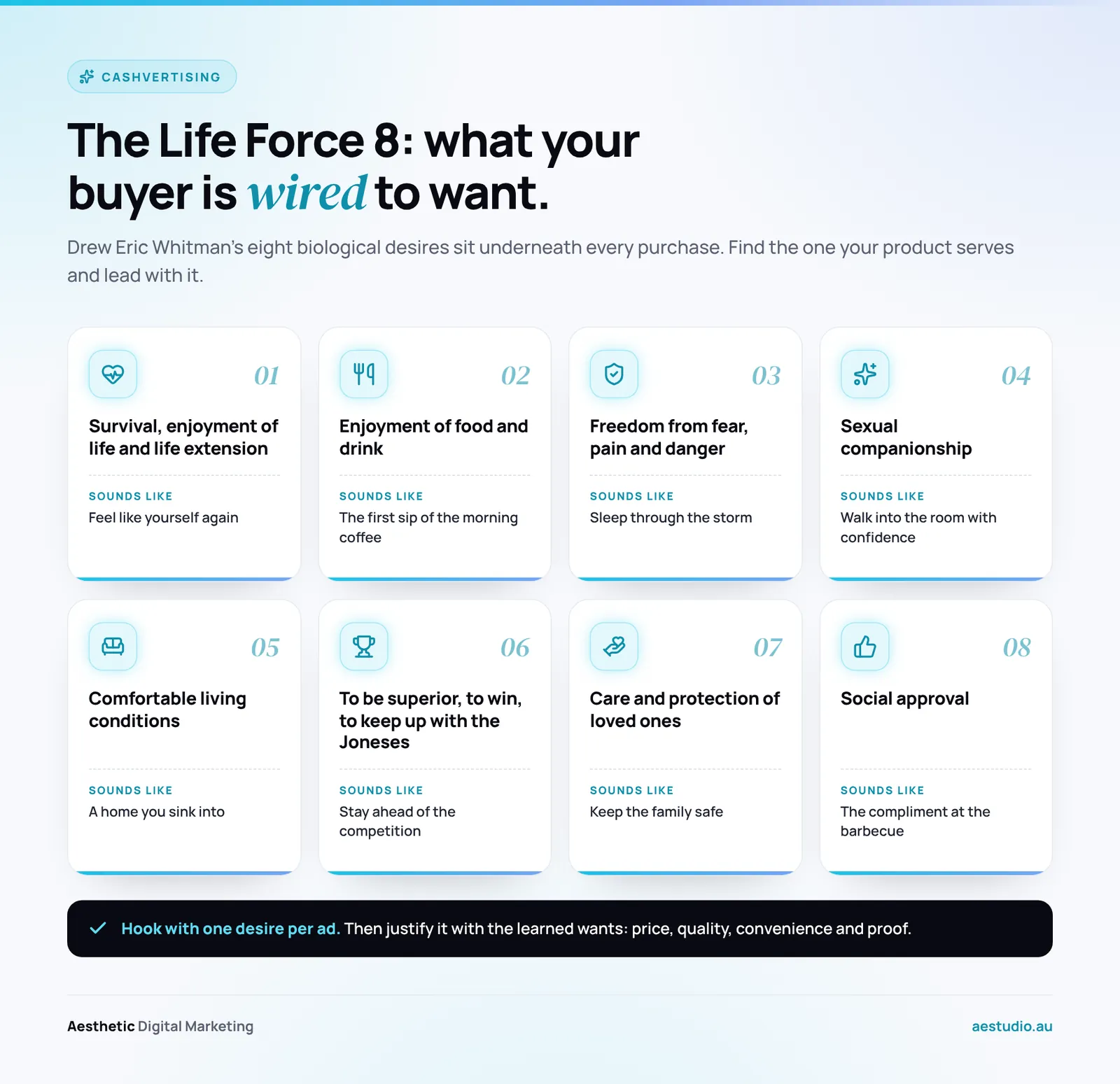
The Life Force 8, one by one
Here’s each desire, what it looks like in real life, and the kind of ad angle it opens up. The example lines are illustrations, not client ads.
1. Survival, enjoyment of life and life extension
The drive to stay alive, stay well and live longer. It powers health, fitness, medical and wellness categories.
Angle: years added, energy back, feeling like yourself again. “Keep up with your kids at 50, not just at 30.”
2. Enjoyment of food and drink
Not just hunger. Taste, ritual and the pleasure of a good meal.
Angle: sensory detail. The crackle of crust, the first sip of the morning coffee. Restaurants, food brands and kitchen products live here.
3. Freedom from fear, pain and danger
One of the strongest levers on the list, and the easiest to misuse. Security, insurance, health, trades and finance all tap into it.
Angle: name the risk calmly, then show the way out. “Don’t find out your switchboard is unsafe during a storm.” Fear also sits behind loss aversion, one of the strongest cognitive biases in marketing. More on doing this ethically further down.
4. Sexual companionship
Whitman doesn’t tiptoe around this one. In practice, for most brands, it’s about attraction, confidence and connection rather than anything explicit.
Angle: how someone feels walking into a room. Fashion, grooming, cosmetic treatments, fragrance and dating apps all lean on it.
5. Comfortable living conditions
A home that feels good to be in. Warmth, space, quiet, a bed you sink into.
Angle: the feeling of the finished space, not the product. Builders, renovators, furniture, heating and cooling, and real estate.
6. To be superior, to win, to keep up with the Joneses
Status and competition. Being ahead, or at least not falling behind.
Angle: what competitors or peers are already doing. “Your competitors are already answering enquiries in under five minutes.” This one quietly drives a lot of B2B buying.
7. Care and protection of loved ones
Often stronger than the desire to look after ourselves. People will spend on their kids, partners, parents and pets in ways they never would for themselves.
Angle: the person they’re doing it for. Child safety, family health, pet care, wills and insurance.
8. Social approval
Being liked, respected and accepted by the group. It’s why reviews, likes and “join 5,000 others” style lines work, and it ties straight into social proof.
Angle: how other people will see them. The compliment at the barbecue, the respect at work, the profile that looks the part.
Learned wants: the nine that sit on top
Whitman also lists nine secondary, or learned, wants. These are desires we pick up from culture and experience rather than biology:
- To be informed
- Curiosity
- Cleanliness of body and surroundings
- Efficiency
- Convenience
- Dependability and quality
- Expression of beauty and style
- Economy and profit
- Bargains
Look familiar? That’s most ad copy. “Fast, convenient, high quality, great value” is four learned wants in a row, and it’s why so many ads blur into each other. It’s also why real brand differentiation matters so much.
Learned wants aren’t useless. They’re just better at justifying a decision than starting one.
| Learned wants | Life Force 8 | |
|---|---|---|
| Where it comes from | Culture, habit and experience | Biology, built in from birth |
| Pull | Moderate, and easy to talk yourself out of | Strong, and hard to ignore |
| Sounds like | “Fast, convenient, great value” | “Sleep through the night again” |
| Best job in an ad | Justifying the decision: features, price, guarantees | Starting the decision: the hook and headline |
| Risk when overused | Every competitor says the same thing | Feels manipulative if the claim isn’t true |
How to use the Life Force 8 in your ads
This is the process I use when an ad account needs fresh angles. It works for Meta ads, Google ad copy, landing pages and email subject lines.
Step 1: run the “so that” ladder
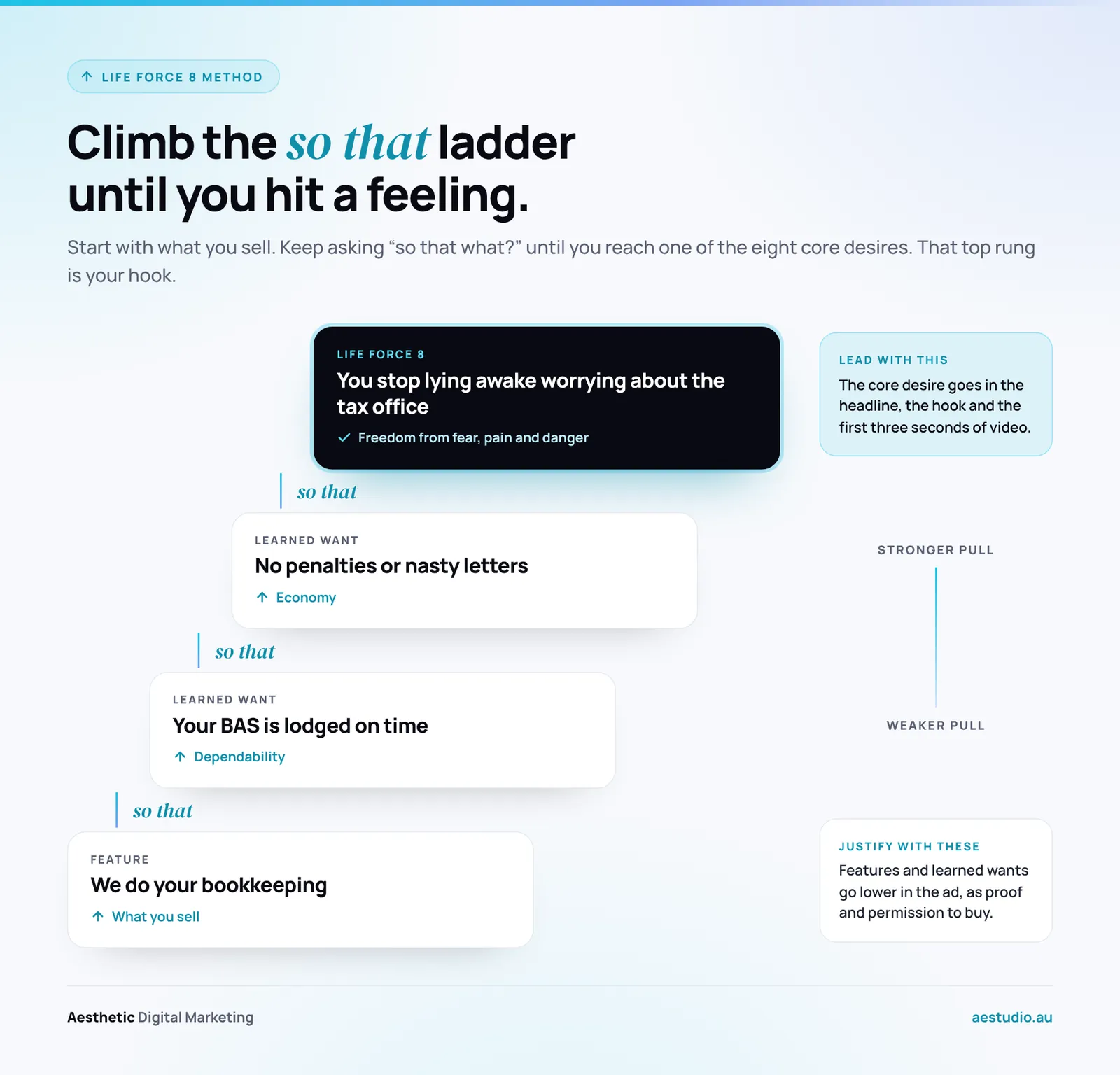
Start with what you sell, then keep asking “so that what?” until you land on one of the eight.
Take a bookkeeping service as an example:
- We do your bookkeeping, so that your BAS is lodged on time
- so that there are no penalties or nasty letters
- so that you stop lying awake worrying about the tax office
That last rung is freedom from fear. It’s a far stronger hook than “accurate, affordable bookkeeping”, which is two learned wants and no feeling at all.
Step 2: pick one desire per ad
Most products touch more than one of the eight. That’s a gift for testing, not an excuse to cram them all into one ad.
The bookkeeping service could also run a status angle (look like you’ve got it together in front of your accountant) and a loved-ones angle (more evenings with the family, less time in spreadsheets). Each one becomes its own ad, and the data tells you which desire your audience responds to.
Step 3: hook with the desire, justify with the learned wants
Lead with the core desire in the first line or the first three seconds of video. Then bring in the learned wants as proof: the price, the turnaround, the guarantee, the reviews.
Emotion starts the decision. Logic gives people permission to finish it. If you want more on that split, my piece on emotional marketing and why features don’t sell goes deeper.
Step 4: make the desire concrete
“Peace of mind” is a learned phrase that nobody feels. “Sleep through the night without checking your phone for alarm alerts” is something a person can picture.
Whitman leans hard on vivid, specific imagery for this reason. The brain responds to what it can see.

B2B clients often tell me their buyers are purely rational. I don’t buy it. The person signing off on a new supplier still wants to look smart to their boss, still wants to avoid the blame if it goes wrong, and still wants to get home on time. That’s status, fear and comfort, three of the eight, sitting quietly inside every procurement form.
Where the Life Force 8 shows up beyond ads
Once you start seeing the eight, you’ll spot them everywhere. A few places they earn their keep:
- Hero headlines. The first line of a homepage should speak to the core desire, not the service category. Pair it with the advice in whether to lead with a problem or a benefit, and with a sharp unique selling proposition.
- Video hooks. The first three seconds decide whether anyone watches the rest. A desire-led hook beats a logo intro every time, which is how we approach ad creative. My guide to the best hooks for ad creatives has more on structure.
- Email subject lines. A subject line built on curiosity (a learned want) gets opens. One built on a core desire gets opens from the right people. It’s the same thinking behind good email marketing.
- Offer design. If your offer only serves learned wants, it’s competing on price. Tie it to a core desire and price matters less. Make it remarkable and you’ve got a purple cow.
Paid advertising
Ads built around what your buyer actually craves.
We write, test and manage Meta and Google ads that start with the desire, then prove it with the details.
Common mistakes with the Life Force 8
- Writing to the learned want only. “Quality workmanship at competitive prices” ticks two learned wants and moves nobody.
- Picking the wrong desire for the audience. A first-home buyer and a downsizer both buy houses. One is chasing status and comfort, the other safety and ease. Same product, different desire.
- Stacking every desire into one ad. An ad that promises health, status, safety and savings all at once lands as none of them.
- Overcooking fear. Fear works, which is exactly why it gets abused. Exaggerated threats can mislead buyers, breach Australian Consumer Law, and fall foul of ad platform policies on sensational content. Name a real risk, calmly, and spend most of the ad on the solution.
- Forgetting the proof. A strong desire with no evidence feels like a stretch. Back it with the details, reviews and credentials and guarantees that make it believable. Cialdini’s principles of persuasion are a useful checklist here.
Is Cashvertising worth reading?
Yes, with a caveat.
The Life Force 8 chapter alone is worth the price. It’s one of the clearest models of buyer motivation in any marketing book, and it’s immediately usable.
The rest of the book is a long run of short copywriting and ad psychology tips. Some are gold. Others show their age, since it was written for print, catalogues and direct mail. The thinking holds up even where the examples don’t.
If you only take one thing from it, take the ladder: what you sell, so that what, until you hit something human. For the other seven frameworks worth studying, head back to the full marketing psychology guide.
More from the marketing psychology series:
- Marketing psychology: 8 frameworks every marketer should study
- Cognitive biases in marketing: 8 that actually move sales
- Purple cow theory: how to be worth talking about
- Brand differentiation: how to stand apart when everyone sounds the same
- Unique selling proposition: how to write one that actually sells
- Cialdini’s 7 principles of persuasion, with marketing examples
- Social proof and authority: how to build trust that converts
- The StoryBrand framework: how to clarify your message
Frequently asked questions
What are the Life Force 8?
The Life Force 8 are eight biologically driven desires identified by Drew Eric Whitman in Cashvertising. They are survival and enjoyment of life, enjoyment of food and drink, freedom from fear and pain, sexual companionship, comfortable living conditions, being superior, care and protection of loved ones, and social approval.
Who wrote Cashvertising?
Drew Eric Whitman, a direct-response copywriter and trainer known as “Dr. Direct”. The book was first published by Career Press in 2008.
What’s the difference between the Life Force 8 and learned wants?
The Life Force 8 are built in from birth, so they pull hard. Learned wants, like convenience, quality and bargains, are picked up from culture and experience. They’re useful for justifying a purchase, but weaker at starting one.
Does the Life Force 8 work for B2B marketing?
Yes. Businesses don’t buy things, people inside them do. A B2B buyer still wants to look good to their boss, avoid blame if a decision goes wrong, and get their evenings back. That’s status, fear and comfort, all straight from the list.
Is it ethical to use fear in advertising?
It can be, if the risk is real and you don’t exaggerate it. Name the problem honestly, then spend most of the ad on the solution. Inflated or false threats mislead buyers and can breach Australian Consumer Law, so keep every claim accurate and provable.
The bottom line
People don’t want your product. They want what it does for one of eight very old, very human desires.
Find which one you serve, lead with it, and let the features do the justifying. Then test a second desire against it and let your audience tell you which one matters most.