Social proof is the fastest trust fix most businesses aren’t using properly. They have the reviews. They just bury them on a testimonials page nobody visits, or paste in “Great service, highly recommend!” and hope it does the heavy lifting.
Social proof and authority are two of Cialdini’s seven principles, but they earn their own article for a practical reason. They’re the two you can improve this afternoon.
This is the final framework in my guide to marketing psychology frameworks every marketer should study. Below is what each one is, the types that work best, where to put them, how to get more reviews, and the Australian rules you need to know before you start.
The short version
Before anyone trusts you, they trust someone else who did.
- Social proof says “people like you chose this”. Reviews, case studies and customer content work best when the person in them looks like your buyer.
- Authority says “someone credible stands behind this”. Real credentials, specific expertise and founder-led content beat vague claims of being experts.
- Specific beats glowing. A review that names the problem, the result and the timeframe outsells five stars and “great service”.
- Put proof next to doubt. Beside the price, the form and the button, not on a page of its own.
- Know the rules. The ACCC bans fake and edited reviews, and registered health services can’t use testimonials in advertising at all.
What is social proof?
Social proof is our tendency to look at what other people are doing when we’re unsure what to do ourselves. Robert Cialdini named it as one of his principles of persuasion, and it’s strongest under two conditions: when the buyer is uncertain, and when the people in the proof feel similar to them.
That second part is the bit most businesses miss. A glowing review from a big corporate client won’t reassure a sole trader. A review from another sole trader will.
What is authority?
Authority is our tendency to trust and follow people who seem credible and knowledgeable. Social proof says “other people chose this”. Authority says “someone who knows what they’re talking about stands behind this”.
Together they answer the buyer’s two biggest questions: is this safe, and are these people any good? You can read how both fit into the bigger picture in my breakdown of Cialdini’s 7 principles of persuasion.
8 types of social proof that actually work
- Specific reviews. Reviews that name the problem, the result and how long it took. Your Google Business Profile is usually the richest source.
- Case studies. The before, the approach and the measurable after, ideally with a real name and face.
- Video testimonials. Harder to fake and easier to believe than text, especially in ads.
- Customer content. Photos, videos and posts from real customers using what you sell. It doubles as some of the best ad creative you can run.
- Customer numbers. A line like “trusted by 400 Illawarra homeowners” only works if the number is true and countable. Never round up.
- Client logos. Recognisable names you’ve genuinely worked with, shown with permission.
- “Most popular” labels. Pointing out the option most customers choose is social proof built right into your pricing.
- Star ratings with a count. 4.8 stars from 212 reviews beats 5.0 stars from 6.
How to build authority
- Show real credentials. Qualifications, licences, certifications and memberships that matter to your buyer.
- Specialise visibly. “We only work with hospitality venues” signals more expertise than “we work with everyone”.
- Teach in public. Detailed, specific content proves expertise far better than the word “experts”. It also helps Google understand who you are, which I cover in entity SEO.
- Put a face to it. A founder or lead practitioner who shows up in content builds authority and liking at the same time.
- Earn third-party mentions. Media features, podcast appearances, awards and partner badges, as long as every one is genuine.
Where to put social proof and authority
Proof works hardest right next to a moment of doubt. Here’s where I place it on client sites:
- Beside the price. The moment someone sees a number is the moment they wonder if it’s worth it.
- Beside the button. A short review or rating directly above “Book now” or “Get a quote”.
- On forms. One line of reassurance next to the fields people hesitate over.
- In the hero. A rating and review count near the headline earns trust in the first few seconds. More in five homepage secrets that increase conversions.
- In your ads. Real customer words make some of the strongest hooks there are.
- At checkout. Guarantees, secure payment signals and delivery reviews, right where carts get abandoned.
A separate testimonials page is fine as an archive. It just shouldn’t be the only place your proof lives.
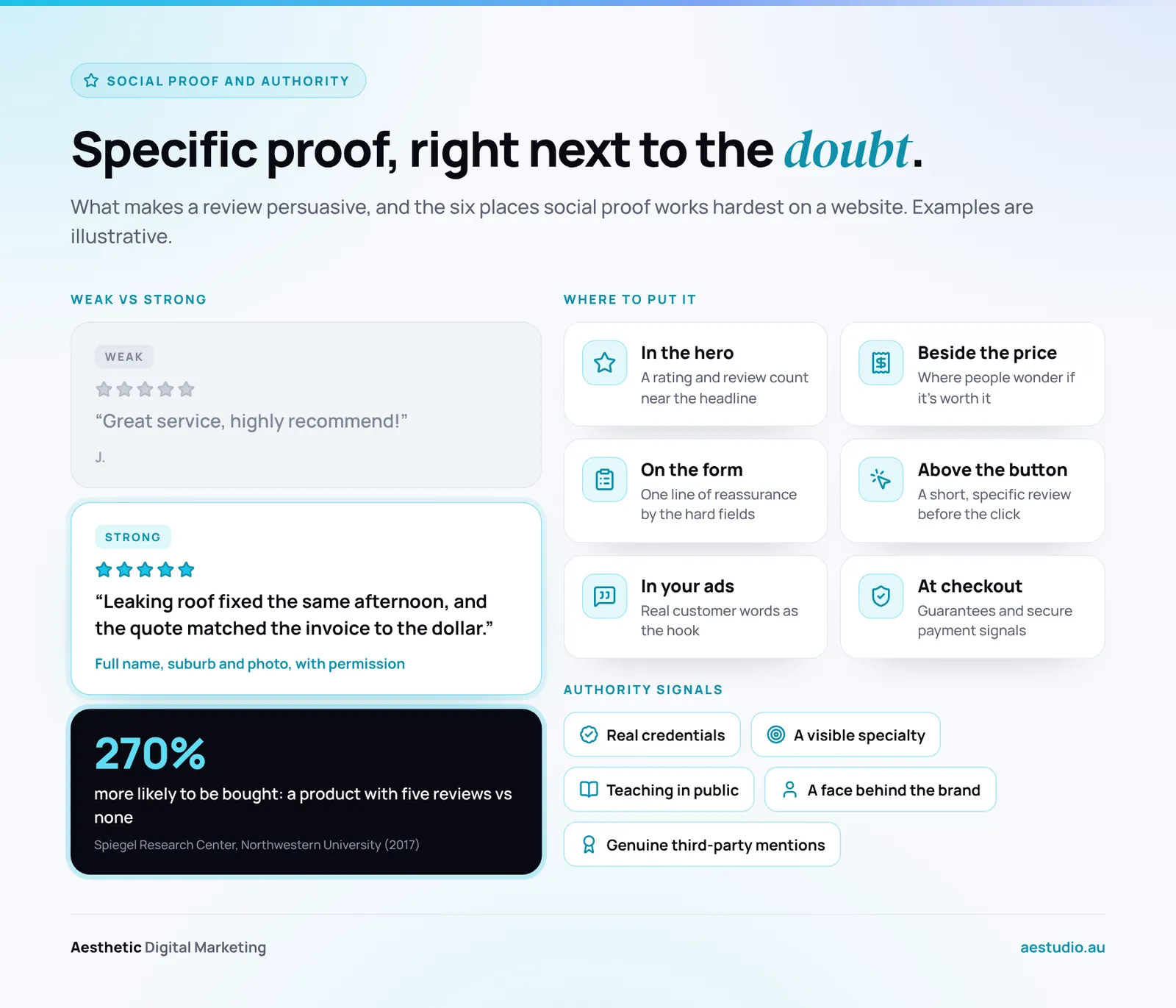
Here’s the difference between weak and strong proof, using made-up examples:
| Weak proof | Strong proof | |
|---|---|---|
| Review | “Great service, highly recommend!” | “Leaking roof fixed the same afternoon, and the quote matched the invoice to the dollar.” |
| Who it’s from | “J.” | A full name, suburb and a photo, shared with permission |
| Rating | 5.0 stars from 6 reviews | 4.8 stars from 212 reviews |
| Authority | “Industry experts” | Licence number, real qualifications and a named lead |
| Where it lives | A testimonials page nobody visits | Beside the price, the form and the button |
Businesses panic about their one bad review. I’d worry more about having only perfect ones. A handful of honest four-star reviews, with a calm, helpful reply from the owner underneath, makes the whole profile more believable. How you respond to criticism is social proof too.
Google Business Profile
Turn happy customers into your best salespeople.
We optimise your Google Business Profile and build a simple, compliant review process so the right proof shows up when people search.
How to get more reviews (the right way)
- Ask at the high point. Right after the job is finished or the result lands, not three weeks later.
- Make it one tap. Send a direct link to your review form by text or email.
- Ask for specifics. “What was the problem, and how did we go?” gets far more useful reviews than “Leave us a review”.
- Reply to every review. Thank the good ones by name. Answer the bad ones calmly and helpfully.
- Build it into the process. Reviews shouldn’t depend on someone remembering. Automate the ask as part of your follow-up, which is where good email marketing earns its keep.
Reviews also feed your local rankings, which I cover in local SEO for Wollongong businesses.
Social proof rules in Australia
This is the part most social proof articles skip, because most of them aren’t written for Australian businesses.
The ACCC rules apply to everyone. Under its online reviews guidance, businesses must not write their own reviews, post fake ones, or publish reviews from staff, family or paid writers without disclosing the connection. You can’t edit or suppress genuine negative reviews either. Incentives are only acceptable when they’re offered regardless of whether the review is positive or negative, and when that’s clearly disclosed.
Health services have stricter rules. If you advertise a regulated health service, including many cosmetic clinics, the National Law bans using testimonials in your advertising. Ahpra’s advertising guidelines define a testimonial as a positive statement about clinical aspects, such as the treatment or outcome. Comments about customer service alone don’t count. Patients can still leave reviews on independent platforms. The problem starts when you use those reviews to promote your service.
For health brands, that shifts the weight onto authority: credentials, clear information and practitioner-led education. I’m not a lawyer, so check the current guidelines or get advice before you build a campaign around reviews in a regulated industry.
More from the marketing psychology series:
- Marketing psychology: 8 frameworks every marketer should study
- Cashvertising’s Life Force 8: the 8 desires behind every sale
- Cognitive biases in marketing: 8 that actually move sales
- Purple cow theory: how to be worth talking about
- Brand differentiation: how to stand apart when everyone sounds the same
- Unique selling proposition: how to write one that actually sells
- Cialdini’s 7 principles of persuasion, with marketing examples
- The StoryBrand framework: how to clarify your message
Frequently asked questions
What is social proof in marketing?
Social proof is the tendency to follow what other people are doing when we’re unsure. In marketing it shows up as reviews, testimonials, case studies, customer numbers and customer content. It works best when the people in the proof are similar to your buyer.
What’s the difference between social proof and authority?
Social proof shows that people like the buyer have chosen you. Authority shows that someone credible stands behind you, through credentials, expertise or third-party recognition. Most strong websites use both.
Do negative reviews hurt sales?
Not necessarily. Research from Northwestern University’s Spiegel Research Center found purchase likelihood peaks at ratings between 4.0 and 4.7, not at a perfect 5.0. A few honest negative reviews with helpful replies can make a profile more believable.
Can I offer incentives for reviews in Australia?
Only in limited ways. The ACCC says any incentive must be offered whether the review is positive or negative, and the incentive must be clearly disclosed. You also can’t write your own reviews, use fake ones, or remove genuine negative reviews.
Can health and cosmetic clinics use testimonials in ads?
Generally no. Under the National Law, advertising for a regulated health service must not use testimonials about clinical aspects such as treatment or outcomes. Comments only about customer service are not counted as testimonials. Check Ahpra’s current guidelines or get advice for your situation.
The bottom line on social proof and authority
Nobody wants to be the first to trust you. Social proof shows them they won’t be. Authority shows them they’re in good hands.
Collect specific reviews, show real credentials, put both right next to the moment of doubt, and play by the rules. It’s the cheapest conversion lift on almost every website I touch.