
Most of what works in marketing psychology fits into eight ideas. There’s a carousel doing the rounds on Instagram that lists them as the things every marketer should study: cognitive biases, purple cow theory, Cialdini, StoryBrand, the lot.
It’s a good list. It’s also the kind of list people screenshot, feel productive about, and never open again.
So I’ve done the opposite. Below is each idea, broken down in plain English, with how I actually use it on ads and websites for our clients. Every section links to a full deep-dive if you want to go further.
The short version
Eight frameworks, one truth: people still buy with an ancient brain.
- Tactics expire, psychology doesn’t. Algorithms change every quarter. The reasons people buy haven’t changed in decades.
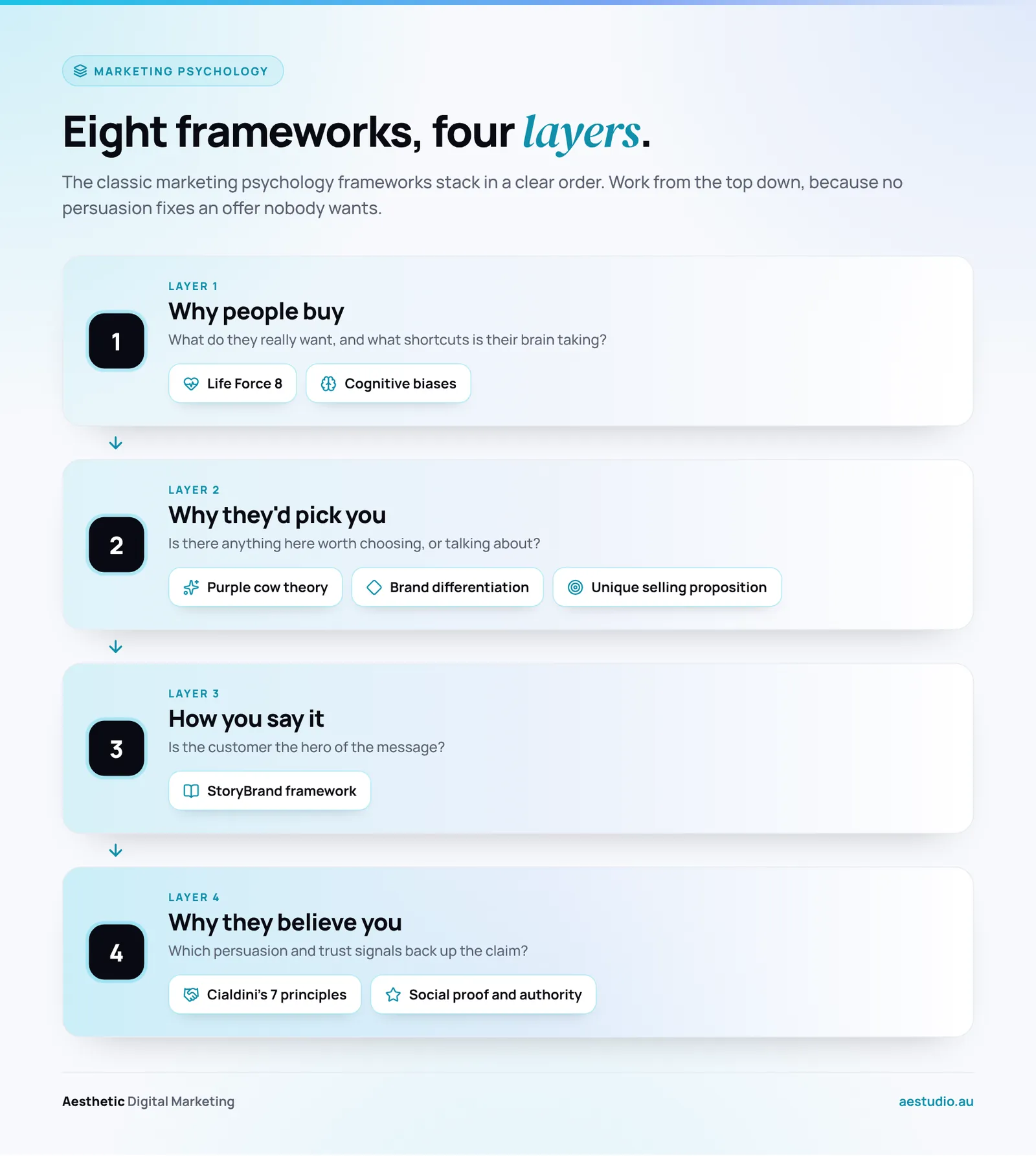
- The eight ideas stack into four layers. Why people buy, why they’d pick you, how you say it, and why they believe you.
- Order matters. No amount of persuasion fixes an offer that looks identical to the one next door.
- Two of the eight overlap. Social proof and authority are already inside Cialdini’s seven. They earn their own slot because they’re the fastest to fix.
- Use it honestly. Real scarcity and real reviews persuade. Fake ones get you caught, and they’re illegal in Australia.
Why marketing psychology outlasts every tactic
Every year there’s a new platform, a new ad format, a new “this changes everything” update from Meta or Google. Most of it matters for about six months.
The person on the other side of the screen hasn’t been updated. They still want to feel safe, look good, save time and avoid regret. They still skim, still compare, and still trust what other people are doing.
That’s why the frameworks on this list have survived decades of channel changes. They don’t describe a platform. They describe the buyer.
I’ve also reordered the list. The carousel runs them in a random order, but they actually stack into four layers, and you should work through them in this sequence:
- Layer one, why people buy: Life Force 8 and cognitive biases.
- Layer two, why they’d pick you: purple cow theory, brand differentiation and unique selling propositions.
- Layer three, how you say it: the StoryBrand framework.
- Layer four, why they believe you: Cialdini’s principles, plus social proof and authority.
1. Cashvertising’s Life Force 8: the desires under every purchase
Drew Eric Whitman’s Cashvertising argues that every purchase traces back to one of eight biologically wired desires. He calls them the Life Force 8:
- Survival, enjoyment of life and life extension
- Enjoyment of food and drink
- Freedom from fear, pain and danger
- Sexual companionship
- Comfortable living conditions
- To be superior, to win, to keep up with the Joneses
- Care and protection of loved ones
- Social approval
Everything else people want (a nicer car, a new website, a skin treatment) is a learned desire sitting on top of one of these.
How I use it: before writing an ad, I ask which of the eight the product actually serves. A cosmetic clinic isn’t selling a treatment. It’s selling social approval and the quiet win of looking great at the reunion. Copy written to the core desire beats copy written to the feature, almost every time, and it’s where every Meta ads campaign we build starts.
If you want the emotional side of this in more depth, my pieces on why feelings sell and features don’t and which emotions make ads convert pair well with it.
Go deeper: Cashvertising’s Life Force 8, explained with ad examples
2. Cognitive biases: the shortcuts your buyer’s brain takes
A cognitive bias is a mental shortcut. The brain uses them to make decisions fast without weighing every option properly. Psychologists Daniel Kahneman and Amos Tversky spent decades mapping them, and the work reshaped economics.
The ones I see most often in marketing:
- Loss aversion. Losing something hurts more than gaining the same thing feels good. “Stop losing leads” often outpulls “get more leads”.
- Anchoring. The first number someone sees sets the frame for every number after it.
- The decoy effect. Adding a deliberately weaker option makes your preferred option look like the obvious pick.
- The default effect. People tend to stick with whatever is pre-selected.
- Scarcity. Things feel more valuable when there’s less of them.
How I use it: mostly on pricing pages, offers and checkout. How a discount is shown can change results more than the size of the discount. We saw that first-hand in our five-market test of slashed prices versus promo codes, and it’s a big part of how we approach conversion rate optimisation.
Go deeper: Cognitive biases in marketing: the ones that actually move sales
3. Purple cow theory: remarkable or invisible
Seth Godin’s Purple Cow starts with a road trip through France. The cows in the fields are charming for the first ten minutes, then you stop noticing them. A purple cow, though? You’d pull over.
His point is that “very good” has become invisible. Safe, competent, inoffensive marketing is now the risky option, because nobody remembers it.
Remarkable literally means worth remarking on. It’s not about being loud. It’s about being the thing people bring up without being asked.
How I use it: I ask clients what a happy customer would tell a friend about them. If the honest answer is “they were good”, there’s no purple cow yet, and no ad budget will create one.
Go deeper: Purple cow theory: how to build something worth talking about
4. Brand differentiation: why “great service” isn’t a position
Differentiation is the reason someone would choose you when a similar option is one tap away.
The trap is claiming things every competitor also claims. Quality, great service, attention to detail, passionate team. If your competitor could paste it onto their homepage unchanged, it’s not a differentiator.
Real differentiation usually lives in one of a few places: who you serve, how you do it, what you refuse to do, or a result you can prove.
How I use it: I lay a client’s homepage next to their three closest competitors and cover the logos. If I can’t tell which one is theirs, we have work to do before we spend a dollar on ads. My piece on brand strategy and why strong brands pay less for attention goes into the commercial side of this.
Go deeper: Brand differentiation: how to stand apart when everyone sounds the same
5. Unique selling propositions: the one reason to pick you
The unique selling proposition (USP) came from Rosser Reeves, an American adman who set out the idea in his 1961 book Reality in Advertising. His rules were strict. A real USP:
- Makes a specific promise of benefit to the buyer
- Is something competitors don’t or can’t offer
- Is strong enough to pull new customers in
The classic example is M&M’s chocolate that melts in your mouth, not in your hand. Specific, unique at the time, and instantly useful.
A USP is not a slogan and it’s not your mission statement. It’s a claim, and you should be able to prove it.
How I use it: the USP becomes the first line of the hero section and the hook of the ad. If it takes a paragraph to explain, it isn’t one yet. Alex Hormozi’s work on offers is a useful companion here, and I’ve broken it down in my $100M Offers review.
Go deeper: Unique selling proposition: how to find yours and prove it
When an account isn’t working, the problem is rarely the targeting. It’s usually an offer that hasn’t answered three questions: why this, why you, why now. Layer two of this list is where most businesses are quietly losing money, and it’s the layer everyone skips because it’s the hardest. Fix it first and the ads get easier to write.
6. The StoryBrand framework: your customer is the hero
Donald Miller’s StoryBrand framework borrows the structure of every story you’ve ever watched. A character wants something, hits a problem, meets a guide who gives them a plan, and is called to action. The story ends in success, or in the failure they managed to avoid.
The twist is where your brand sits. You’re not the hero. Your customer is. You’re the guide, the Yoda, the one with the plan.
Most websites get this backwards. They open with “we” and spend three sections on the company before the visitor sees their own problem on the page.
How I use it: StoryBrand is how I structure most homepages and landing pages. Problem first, empathy and authority second, a simple three-step plan, then one clear call to action. You can see it laid out section by section in our StoryBrand landing page example, and it shapes every website we design. It’s also the fastest fix for a site that feels confusing, which matters more than people think, as I explain in why unclear brands feel risky.
Go deeper: The StoryBrand framework, reviewed with a landing page template
7. Cialdini’s 7 principles of persuasion
Robert Cialdini’s Influence is probably the most quoted persuasion book in marketing. He originally named six principles, then added a seventh, unity, in his 2016 book Pre-Suasion.
- Reciprocity. Give first and people feel a pull to give back.
- Commitment and consistency. A small yes makes a bigger yes more likely.
- Social proof. When unsure, we copy what people like us are doing.
- Authority. We defer to credible experts.
- Liking. We say yes to people we like and relate to.
- Scarcity. Limited things feel more valuable.
- Unity. We say yes to people we see as part of our own group.
How I use it: as a checklist on landing pages and email flows. A free audit or guide covers reciprocity. A quiz or short form is a small commitment. Founder-led content builds liking. Most pages I review use two or three of the seven. The best ones use five or six without feeling pushy.
Go deeper: Cialdini’s 7 principles of persuasion, with marketing examples
8. Social proof and authority: borrowed trust
You’ll notice these two are already in Cialdini’s list. The carousel gives them their own slot, and I agree with it, for one practical reason. They’re the two principles you can add to a page this afternoon.
Social proof says “people like you already chose this”. Reviews, testimonials, case studies, customer counts you can actually verify, user-generated content. For most local businesses, the richest source is a well-run Google Business Profile.
Authority says “someone credible stands behind this”. Qualifications, media mentions, partner badges, a founder who clearly knows their stuff.
The detail that matters most is specificity. “Great service, highly recommend” does very little. A review that names the problem, the result and the timeframe does a lot of heavy lifting.
How I use it: proof goes right next to the moment of doubt. Reviews beside the price. A credential beside the claim. A case study beside the call to action. Proof buried on a separate testimonials page is proof nobody reads.
Go deeper: Social proof and authority: how to build trust that converts
The 8 marketing psychology frameworks at a glance
Here’s the cheat sheet. Save this part if nothing else.
| Framework | The question it answers | Where to use it first |
|---|---|---|
| Life Force 8 | What does my buyer really want underneath the purchase? | Ad angles and hooks |
| Cognitive biases | What shortcuts is my buyer’s brain taking? | Pricing, offers and checkout |
| Purple cow theory | Is there anything here worth talking about? | Product and offer design |
| Brand differentiation | Why us instead of the similar option next door? | Homepage and brand positioning |
| Unique selling proposition | What’s the one specific promise only we can make? | Hero headline and ad hook |
| StoryBrand | Is the customer the hero of my message? | Website and landing page structure |
| Cialdini’s 7 principles | Which persuasion levers am I using, and which am I missing? | Landing pages and email flows |
| Social proof and authority | Why should they believe me? | Next to price and call to action |
Strategy call
Find out which of the eight your marketing is missing.
Bring your ads and your website. We’ll walk through them together and show you where the message is leaking sales.
How to study marketing psychology without reading eight books
You don’t need to clear a bookshelf this weekend. Here’s the order I’d go in if I were starting again:
- Start with layer two. Differentiation and your USP. If your offer looks like everyone else’s, nothing downstream works properly.
- Then fix the message with StoryBrand. It’s the most practical of the eight and you can apply it to your homepage in an afternoon.
- Audit a page against Cialdini. Print your best landing page, list the seven principles down the side, and tick off which ones show up.
- Use Life Force 8 and cognitive biases for testing. They’re brilliant for generating new ad angles and offer variations to test against each other.
- Revisit purple cow theory last. It’s the hardest one, because it usually means changing the product, not the marketing.
Whatever you do, test it. Psychology tells you what’s likely to work. Your own data tells you what actually does. If you want to sharpen that side, my guide to conversion rate optimisation is a good next read.
Frequently asked questions
What is marketing psychology?
Marketing psychology is the study of how people actually make buying decisions, and using that understanding to shape offers, messages and websites. It covers emotions, mental shortcuts, trust and social influence. Frameworks like Cialdini’s principles, StoryBrand and Life Force 8 are practical ways to apply it.
Which marketing framework should I learn first?
I’d start with brand differentiation and your unique selling proposition. Persuasion techniques can’t rescue an offer that looks the same as every competitor’s. Once you know why someone should pick you, StoryBrand is the fastest way to turn that into a clear message.
Is using psychology in marketing manipulative?
It depends on whether it’s true. Real scarcity, genuine reviews and honest credentials help people make a decision they’ll be happy with. Fake countdown timers, invented reviews and false claims are manipulation, and misleading conduct like this can breach Australian Consumer Law. Use psychology to remove doubt, never to create false impressions.
Are Cialdini’s principles still relevant?
Yes. The channels have changed since Influence was first published in 1984, but people haven’t. Reviews, creator content, free trials and limited drops are all modern versions of social proof, liking, reciprocity and scarcity.
What’s the difference between a USP and brand differentiation?
Brand differentiation is the bigger picture of how you’re different, including who you serve, how you work and what you stand for. A USP is one specific, provable promise pulled from that, short enough to lead a headline or an ad. Differentiation is the strategy. The USP is the sharpest line from it.
Do I need to read all eight books?
No. Read the ones that match your biggest problem. If people don’t understand what you do, read StoryBrand. If they understand but don’t buy, read Cialdini. When nobody notices you at all, read Purple Cow. The deep-dives linked above give you the useful parts of each.
The bottom line on marketing psychology
That carousel is right. If you’re in marketing, these eight are worth studying. But studying them isn’t the point. Using them in the right order is.
Work out why people buy. Give them a reason to pick you. Tell it with them as the hero. Then back every claim with proof. Do that and the ads, the emails and the website all start pulling in the same direction.