You know when someone says, “I just need a simple website,” and then hands you a 47-tab Google Doc and a Pinterest board titled Mood?
Yeah. It’s never just a website.
If you’re wondering why websites cost more than you expected, or why timelines stretch longer than “just throwing something together,” this one’s for you. Because a high-performing website isn’t just about what it looks like. It’s about what it does, who it speaks to, and how it moves people to act.
So what actually goes into building a website that works? Here’s the behind-the-scenes breakdown.
You’re not paying for a website. You’re paying for what makes it sell.
- Strategy first, pixels later. Discovery, positioning and messaging decide whether the site converts.
- Structure is the skeleton. A sitemap and user flow map how people move toward action.
- Copy does the selling. Great design with weak words still loses the click.
- Design and dev make it real. On-brand, fast, responsive, and easy to edit.
- Launch is the start, not the finish. A good site keeps evolving with the business behind it.
Before we break down the six stages, a quick gut-check: is your current site actually earning its keep, or just sitting there? Take 60 seconds to find out.
Discovery and strategy: the bit most people skip (but shouldn’t)
This is where we dive deep. Not into colours and fonts, but into your goals, your audience, your offer and your positioning. It’s the business therapy you didn’t know you needed. We ask a lot of questions, like “what makes your brand different?” and “why should anyone care?”, because your website has to say the right thing to the right person, or it’s just noise.
Why it earns its place first: design without strategy is decoration. Strategy gives your site direction, clarity and impact, so it actually converts instead of just existing.
How we do it: we run a full strategy workshop, then create two documents that steer every decision after them:
- A Customer Persona Profile that breaks down your ideal client’s mindset
- A StoryBrand Messaging Framework to guide every word and design choice
Sitemap and UX: your website’s skeleton
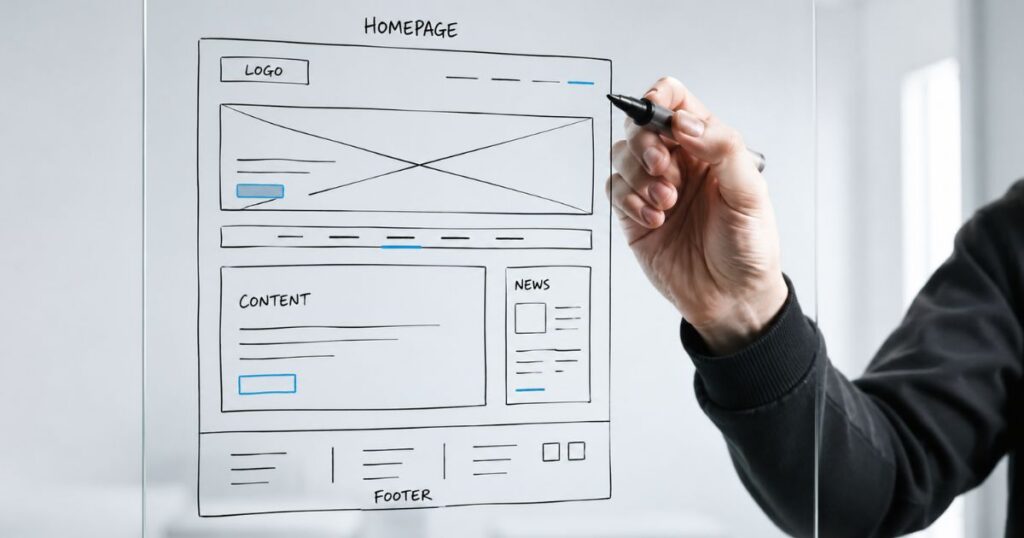
This is your structure: the pages, the flow, the logic. What content goes where, and how users move through your site. If people can’t find what they need in a few seconds, they’re gone, so a good sitemap and user flow keeps them engaged, reduces friction and leads them toward action.
How we do it: we analyse your audience’s behaviour with tools like Google Analytics, map a clear journey, then build wireframes in Figma for every page, not just the homepage. Yes, that includes the ones everyone forgets:
- 404 pages
- Thank-you pages
- Blog article templates
- Calendar booking flows
- Product or pricing page templates
It’s the least glamorous stage and the most profitable, which is why we gave it a guide of its own: sitemaps and user flows, the planning step everyone skips. Get it right and you stop leaking leads halfway down the page.
Website copywriting: talk like a human, sell like a pro
Words that convert, not just filler. Strategic messaging that answers questions, removes doubt and builds trust. Good design is great, but good design with great copy is where the real value is. Copy is the difference between a visitor who clicks away and one who buys.
How we do it: we co-write your copy with you inside Figma, using the StoryBrand framework as our guide. You bring the expert insight, we bring the clarity and conversion psychology. Want to go deeper on writing web copy? Here’s how to write website copy that actually converts.
UI design: make it look like you (but better)
UI is your user interface, how your site looks and feels: layout, branding, colours, fonts and imagery. It builds trust, supports the message and makes navigation intuitive. A good-looking site isn’t enough on its own; it has to feel like your brand and guide users toward action.
How we do it: we design your site in Figma from scratch, not from cookie-cutter templates, with your goals, brand and users in mind. On WordPress we’ve got room to get creative. On Shopify or other builders, we work smart within the limits to make your site stand out without breaking things.

Development: the tech that makes it real
Development is where everything comes to life: code, speed, responsiveness and functionality all live here. A slow or broken site is worse than no site at all, because performance touches everything from user experience to SEO and conversion rate. This is the build half of web design versus web development, and it’s where a beautiful design either performs or falls over.
How we do it: we develop sites that are:
- Fast-loading (we check with Google PageSpeed Insights)
- Fully responsive across devices
- Optimised for SEO
- Editable without needing a developer for every change
The whole build, handled
Strategy, design, copy and dev, one team.
You bring the business. We bring the process that turns it into a site that actually sells, no 47-tab Google Doc required.
See how we build websitesPost-launch support: because it doesn’t end at go live
This is everything that happens after launch: tech support, small edits, performance tweaks and the “how do I change this again?” kind of help. Your business will evolve. You’ll launch new offers, create content, test ideas, and your site should evolve with you, not hold you back.
Every website we build includes:
- Domain and plugin support
- Speed optimisation
- Design direction as your brand evolves
- Technical help and troubleshooting
- Coaching and support after launch
The bottom line
You’re not just paying for “a website.” You’re investing in strategy that sells, messaging that connects, design that builds trust, functionality that works, and support that keeps you moving. Here’s the difference that actually makes:
| What you get | A DIY placeholder | A build that works |
|---|---|---|
| Strategy | None. You guess. | Discovery, positioning and a real plan |
| Messaging | Whatever you type in the box | StoryBrand copy that answers objections |
| Design | A template with your logo dropped on | On-brand UI built around your users |
| Functionality | Hope it holds | Fast, responsive, SEO-ready, editable |
| After launch | You’re on your own | Support, speed, fixes and coaching |
If you want a simple placeholder, you can build that yourself. If you want a site that looks sharp, converts better and grows with your business, that’s what we do, and here’s what it actually costs.
Let’s build you the site your brand deserves.
Frequently asked questions
What actually goes into building a website?
Six stages: discovery and strategy, sitemap and UX planning, copywriting, UI design, development, and post-launch support. The visible design is only one of them. Most of the value lives in the strategy and structure underneath, which is why a real build takes longer than “just throwing something together.”
Why do websites cost more and take longer than expected?
Because the price isn’t pixels, it’s the strategy, messaging, structure and testing that make a site convert. That groundwork is invisible, but it’s where most of the work lives. Here’s what a website really costs and why the cheap option is usually the expensive one.
What’s the first step in building a website?
Strategy, not design. Discovery defines your goals, audience and positioning, then a sitemap and user flow map how people move through the site. Skipping this is the most expensive shortcut in web design, so we cover it in sitemaps and user flows.
Do I really need a strategy phase for a small site?
Yes. Even a small site has to say the right thing to the right person, or it’s just noise. The strategy stage is cheap to change, a built page isn’t, so the thinking is far cheaper to do up front than to redo later.
What’s included after launch?
Domain and plugin support, speed optimisation, design direction as your brand evolves, technical help, and coaching. Your site should grow with you, not hold you back, so support doesn’t stop at go live.