

Cognitive biases in marketing get talked about like secret mind-control tricks. They’re not. They’re the mental shortcuts every buyer takes, every day, to avoid thinking too hard about decisions that don’t seem to deserve it.
Your job isn’t to exploit those shortcuts. It’s to stop accidentally fighting them. Most pricing pages, offers and checkouts I review are working against the buyer’s brain without anyone realising.
This is the second framework in my guide to marketing psychology frameworks every marketer should study. Below are the eight biases I see move sales most often, the research behind each, where to use them, and one famous bias that probably doesn’t deserve its reputation.
The short version
Your buyer isn’t irrational. They’re taking shortcuts.
- Biases are shortcuts, not flaws. The brain uses them to decide fast. Good marketing makes the right decision the easy one.
- Pricing is where they matter most. Anchors, decoys and defaults can shift what people buy without changing a single price.
- Framing changes the decision. The same fact, worded as a gain or a loss, gets a different response.
- Not every famous bias holds up. Choice overload is the classic example. Test before you redesign around it.
- Honest beats clever. Fake scarcity and hidden defaults can breach Australian Consumer Law and wreck trust.
What are cognitive biases in marketing?
A cognitive bias is a predictable pattern in how people judge and decide. It isn’t random error. It’s the brain using a rule of thumb to save effort.
Psychologists Amos Tversky and Daniel Kahneman mapped many of these shortcuts from the 1970s onwards, starting with their 1974 paper in Science, Judgment under Uncertainty: Heuristics and Biases. Kahneman later won a Nobel prize for the work.
In marketing terms, cognitive biases explain why people react to how something is presented, not just what it is. Two identical offers can perform completely differently depending on the order, the wording and what sits next to them.
That’s good news. It means a lot of conversion gains don’t need a bigger budget or a cheaper price. They need a better-designed decision.
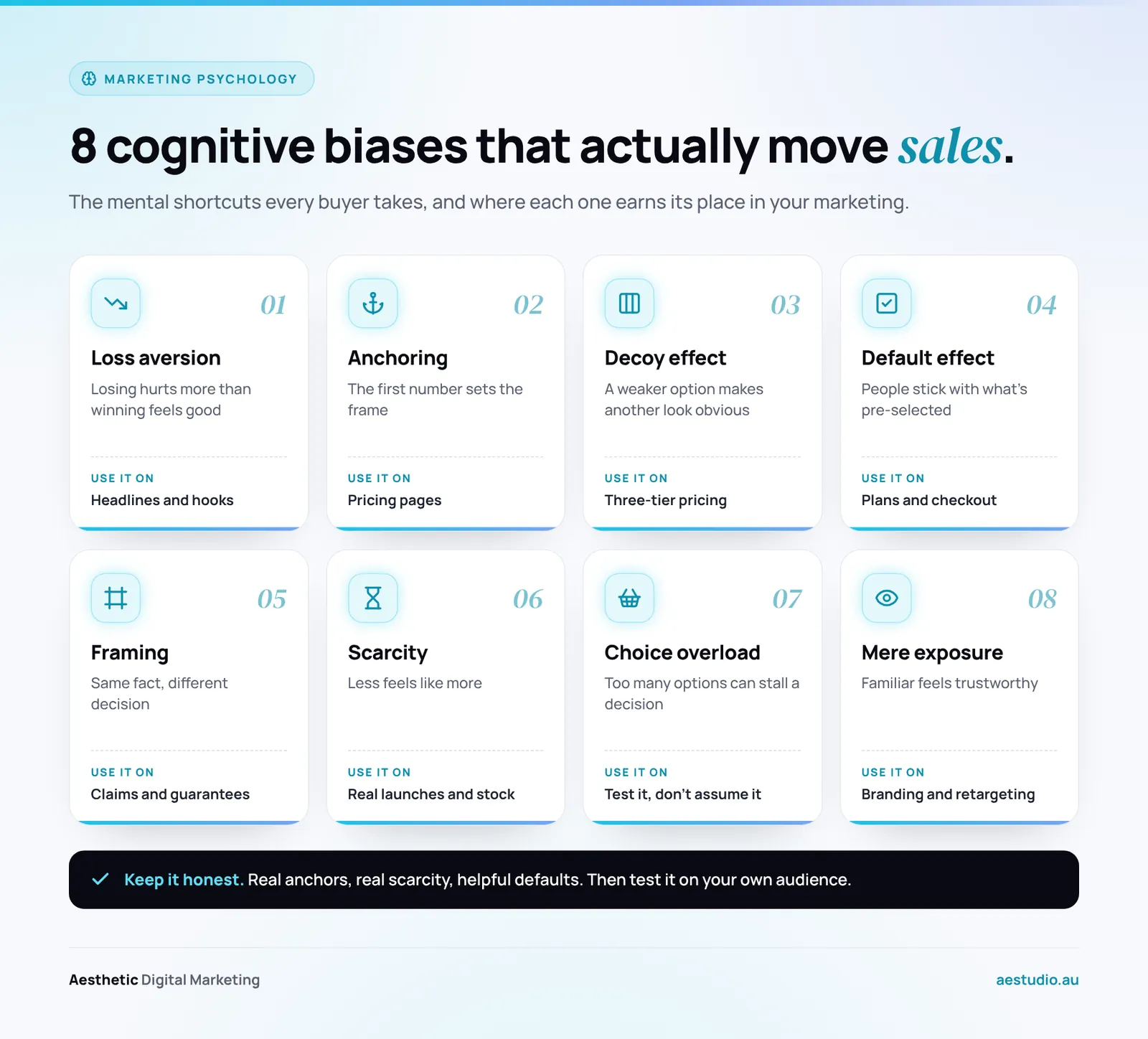
1. Loss aversion: losing hurts more than winning feels good
Loss aversion is the finding that a loss feels heavier than a gain of the same size. Losing $50 stings more than finding $50 feels nice. It sits at the heart of Kahneman and Tversky’s prospect theory.
Where to use it: headlines, ad hooks and offer framing. “Stop losing leads after hours” often pulls harder than “get more leads”. Free trials work partly because cancelling feels like giving something up.
Watch out: don’t invent losses that aren’t real. Name the cost of doing nothing honestly, then show the way out. It pairs naturally with the “freedom from fear” desire in Cashvertising’s Life Force 8.
2. Anchoring: the first number sets the frame
Anchoring is the tendency to lean heavily on the first number we see, even when it’s irrelevant. In Tversky and Kahneman’s experiments, an arbitrary number shown first was enough to pull people’s estimates towards it.
Where to use it: pricing pages and offers. Show the premium package first. Show the original price next to the sale price. Mention the cost of the problem before the cost of the fix.
How you display a discount matters as much as its size. We saw that first-hand in a five-market test of slashed prices versus promo codes.
Watch out: the anchor has to be genuine. A “was” price nobody ever paid is misleading, and the ACCC takes a dim view of it.
3. The decoy effect: the option nobody’s meant to buy
Add a third, deliberately weaker option, and one of the original two suddenly looks like the obvious choice. That’s the decoy effect.
The best-known example comes from behavioural economist Dan Ariely. He described a magazine offer with a web-only subscription, a print-only subscription, and print plus web for the same price as print alone. Nobody wanted print-only, but its presence pushed people towards the bundle.
Where to use it: three-tier pricing. Design the middle or top tier as the one you want people to choose, and make sure the tier beside it makes it look like great value.
Watch out: every tier should still be a real, buyable option. A decoy that’s obviously fake makes the whole page feel like a trick.
4. The default effect: people stick with what’s ticked
People tend to accept whatever option is pre-selected. Changing it takes effort, and the default feels like a recommendation.
The famous study is Johnson and Goldstein’s 2003 work on organ donation. Countries where donation was the default had consent rates around five times higher than countries where people had to opt in. Same people, same choice, different starting point.
Where to use it: pre-select the plan most customers should be on. Default to annual billing if it genuinely suits them. Pre-tick the delivery option most people choose anyway.
Watch out: never pre-tick add-ons people didn’t ask for, or opt them into marketing they didn’t agree to. That’s where defaults stop being helpful and start being a dark pattern.
5. Framing: same fact, different decision
The framing effect is when the same information gets a different response depending on how it’s worded. A classic consumer study found people rated beef labelled “75% lean” more favourably than beef labelled “25% fat”, even though it’s the same meat.
Where to use it: claims, guarantees and pricing. “$2 a day” lands differently to “$730 a year”. “Join the 9 in 10 clients who renew” lands differently to “1 in 10 leave”. A clearly framed guarantee is also the backbone of a strong unique selling proposition.
Watch out: framing should make a true fact easier to understand, not hide a worse one. If the reframe would make a customer feel misled once they did the maths, don’t use it.
6. Scarcity: less feels like more
Things feel more valuable when they’re limited, whether by quantity, time or access. It’s one of the oldest levers in selling, and it overlaps with scarcity in Cialdini’s principles of persuasion.
Where to use it: genuine launches, limited stock, booking calendars with real capacity, seasonal offers with a real end date.
Watch out: fake countdown timers that reset on refresh, and “only 2 left” messages that never change. Buyers spot them quickly, and false urgency can breach Australian Consumer Law. Real scarcity sells. Fake scarcity gets screenshotted.
7. Choice overload: the famous bias that might not be real
Choice overload is the idea that too many options make people freeze and buy nothing. It’s usually told through the “jam study”, where a tasting table with more flavours drew more browsers but fewer buyers.
Here’s the catch. When researchers pooled dozens of choice overload experiments, the average effect came out close to zero. Sometimes more choice hurt. Often it made no difference. Sometimes it helped.
Where to use it: as a hypothesis, not a rule. Fewer options can help when products are hard to compare, when people are new to the category, or when the choices look identical. Comparison filters and a clear “most popular” pick often fix the problem without cutting your range.
Watch out: don’t strip your catalogue on the strength of one famous study. Test it, which is exactly what A/B testing is for.
8. Mere exposure: familiarity breeds trust
The mere exposure effect, first studied by psychologist Robert Zajonc in the 1960s, is our tendency to like things more simply because we’ve seen them before.
Where to use it: consistent branding, retargeting and frequency. Someone who has seen your brand a few times is more likely to trust it when they’re finally ready to buy. That’s the quiet job retargeting ads do, and it’s why we set up Google remarketing for most clients.
Watch out: familiarity has a ceiling. Showing the same ad too often turns warmth into irritation, which is why ad frequency deserves watching. My take on Meta’s frequency controls covers where that line sits.

The bias I see wasted most often is the default. Businesses agonise over their prices, then launch a pricing page with nothing pre-selected and three tiers that look identical. Decide which option most customers should be on, make it the default, and label it honestly. It’s usually the cheapest conversion fix on the whole site.
Cognitive biases in marketing at a glance
Here’s the cheat sheet for all eight.
| Bias | Use it on | Watch out for |
|---|---|---|
| Loss aversion | Headlines, hooks and offer framing | Inventing losses that aren’t real |
| Anchoring | Pricing pages, sale prices, the cost of the problem | “Was” prices nobody ever paid |
| Decoy effect | Three-tier pricing | Tiers so obviously fake they feel like a trick |
| Default effect | Pre-selected plans, billing and delivery | Pre-ticked add-ons and marketing opt-ins |
| Framing | Claims, guarantees and price breakdowns | Reframes that hide a worse fact |
| Scarcity | Real launches, stock limits and capacity | Countdown timers that reset on refresh |
| Choice overload | Hard-to-compare ranges, as a test | Cutting your range on the strength of one study |
| Mere exposure | Branding, retargeting and frequency | Showing the same ad until people resent it |
Conversion rate optimisation
Pricing pages and checkouts built to nudge, not nag.
We audit where your site is fighting your buyer’s brain, then test the fixes so you know what actually moved the numbers.
How to use cognitive biases in marketing without being sleazy
There’s a fine line between helping someone decide and tricking them into a decision they’ll regret. A few rules I hold every client account to:
- Every claim has to be true. Real anchors, real scarcity, real reviews. If you’d be embarrassed explaining it to the ACCC, don’t run it.
- Make the good choice easy, not the bad choice hard. A helpful default speeds people up. A hidden opt-out traps them.
- Pass the screenshot test. If a customer screenshotted your page and posted it with “look what they’re doing”, would you be fine with that?
- Test, don’t assume. Biases are tendencies, not laws. Your audience might not respond the way a 1970s lab study did, so measure it.
- Pair biases with proof. A well-framed offer still needs evidence. That’s where social proof and authority do the heavy lifting.
Used this way, cognitive biases aren’t manipulation. They’re good design for how people actually think.
More from the marketing psychology series:
- Marketing psychology: 8 frameworks every marketer should study
- Cashvertising’s Life Force 8: the 8 desires behind every sale
- Purple cow theory: how to be worth talking about
- Brand differentiation: how to stand apart when everyone sounds the same
- Unique selling proposition: how to write one that actually sells
- Cialdini’s 7 principles of persuasion, with marketing examples
- Social proof and authority: how to build trust that converts
- The StoryBrand framework: how to clarify your message
Frequently asked questions
What are cognitive biases in marketing?
Cognitive biases in marketing are the predictable mental shortcuts buyers use to make decisions, such as loss aversion, anchoring, defaults and framing. Marketers use them to present offers in a way that matches how people actually think, so the right choice feels easy.
Which cognitive bias is most effective in marketing?
It depends on where the decision happens. Anchoring and the decoy effect do the most work on pricing pages. Loss aversion is strongest in headlines and ad hooks. Defaults are often the quickest win in checkouts and sign-up forms. Test them on your own audience rather than assuming one is best.
Is using cognitive biases in marketing manipulative?
It’s manipulative when it relies on something false, like fake scarcity, invented “was” prices or pre-ticked add-ons. It’s good design when it helps people understand a true offer faster. Misleading conduct can also breach Australian Consumer Law, so every claim needs to be accurate.
What’s the difference between cognitive biases and Cialdini’s principles?
They overlap. Cognitive biases are the broad research on how people judge and decide. Cialdini’s principles, like reciprocity, scarcity and social proof, are a persuasion-focused selection of those tendencies, packaged for sales and marketing.
Is choice overload real?
Sometimes. The famous jam study suggested too many options stop people buying, but a meta-analysis of 50 experiments found the average effect was close to zero. Fewer options can help when products are hard to compare, so test it rather than cutting your range by default.
The bottom line on cognitive biases in marketing
Your buyer is busy, distracted and deciding fast. Cognitive biases are simply the rules their brain uses to cope.
Work with those rules honestly. Set a genuine anchor, pick a sensible default, frame the truth clearly and keep scarcity real. Then test it, because the only bias study that matters is the one you run on your own customers.