

Purple cow theory comes from a road trip. Seth Godin was driving through France, admiring the cows in the fields. Twenty minutes later he’d stopped noticing them. They were still lovely cows. They just weren’t news anymore.
A purple cow, though? You’d pull over, take a photo and tell everyone you know.
That’s the whole idea, and it’s the third framework in my guide to marketing psychology frameworks every marketer should study. Here’s what purple cow theory actually says, why “very good” has quietly become invisible, and how to find the thing about your business that’s genuinely worth talking about.
The short version
Nobody shares “very good”. Build something worth a detour.
- Remarkable means worth remarking on. It’s not about being loud. It’s about being the thing people mention without being asked.
- Safe is now the risky option. In a crowded feed, competent and inoffensive is the fastest way to be ignored.
- The product is the marketing. Purple cows get built into what you sell and how you deliver it, not bolted onto the ad.
- Build for the people who spread ideas. Win over a small group who care deeply, and they’ll carry you to everyone else.
- Ads amplify remarkable. They can’t create it. A boring offer just gets ignored more expensively.
What is purple cow theory?
Purple cow theory is the central idea of Seth Godin’s book Purple Cow: Transform Your Business by Being Remarkable, published by Portfolio in 2003. True to form, Godin’s first self-published edition shipped inside a milk carton.
The argument is simple. Advertising has lost much of its power because people are drowning in it and actively avoid it. So the only reliable way to get attention is to build something remarkable, and to market it in a remarkable way.
As Godin puts it, being boring is now the surest way to fail.
The brown cows are every business that’s good, reliable and indistinguishable. The purple cow is the one people can’t help talking about.
Why “very good” became invisible
For most of the twentieth century, marketing ran on a simple formula. Make an average product for an average customer, then buy enough TV, radio and print to interrupt people until they remembered you.
Godin called this the TV-industrial complex, and it worked because attention was cheap and choice was limited.
Neither is true anymore. Your customer has more options than they can compare, and they scroll past more ads in a morning than their grandparents saw in a week. Being “very good” just gets you into the pile of very good options nobody remembers.
That’s why so many small businesses feel stuck. They’re doing good work. It just isn’t the kind of good that travels.
Remarkable doesn’t mean loud
This is where most people get purple cow theory wrong. They hear “remarkable” and think stunts, neon colours and shock value.
Remarkable literally means worth making a remark about. Plenty of purple cows are quiet. A few illustrations of what that can look like:
- A plumber who sends a short video of the problem and the fix before they leave the job.
- A clinic that texts you the next day to ask how you’re feeling, from an actual person, not a system.
- An accountant who answers emails the same day, every day, in an industry famous for not doing that.
- A café that remembers your order by the second visit.
None of those are loud. All of them get mentioned at dinner. That’s the test.
Sneezers: who you’re really building for
Godin’s other big idea is that you shouldn’t build for everyone. You build for the small group of people who are most likely to spread an idea. He calls them sneezers.
Sneezers are the early adopters, the enthusiasts, the people in your niche who obsess over the details and love telling others what they’ve found. Win them over and they do your marketing for you. It’s unity, the newest of Cialdini’s principles of persuasion, in action.
Aim at the average customer and you end up with an average product, which is exactly the brown cow you were trying to avoid.
It’s the same reason influencer marketing works best when the creator genuinely cares about the category. A sneezer with a real opinion beats a big audience with no interest.
Safe is risky: the purple cow theory paradox
The most uncomfortable part of the book is this. The thing that feels safe (blending in, copying what competitors do, not upsetting anyone) is now the riskiest strategy you can pick.
Blending in doesn’t fail loudly. It fails slowly, as rising ad costs, flat referrals and customers who choose on price because they can’t see any other difference.
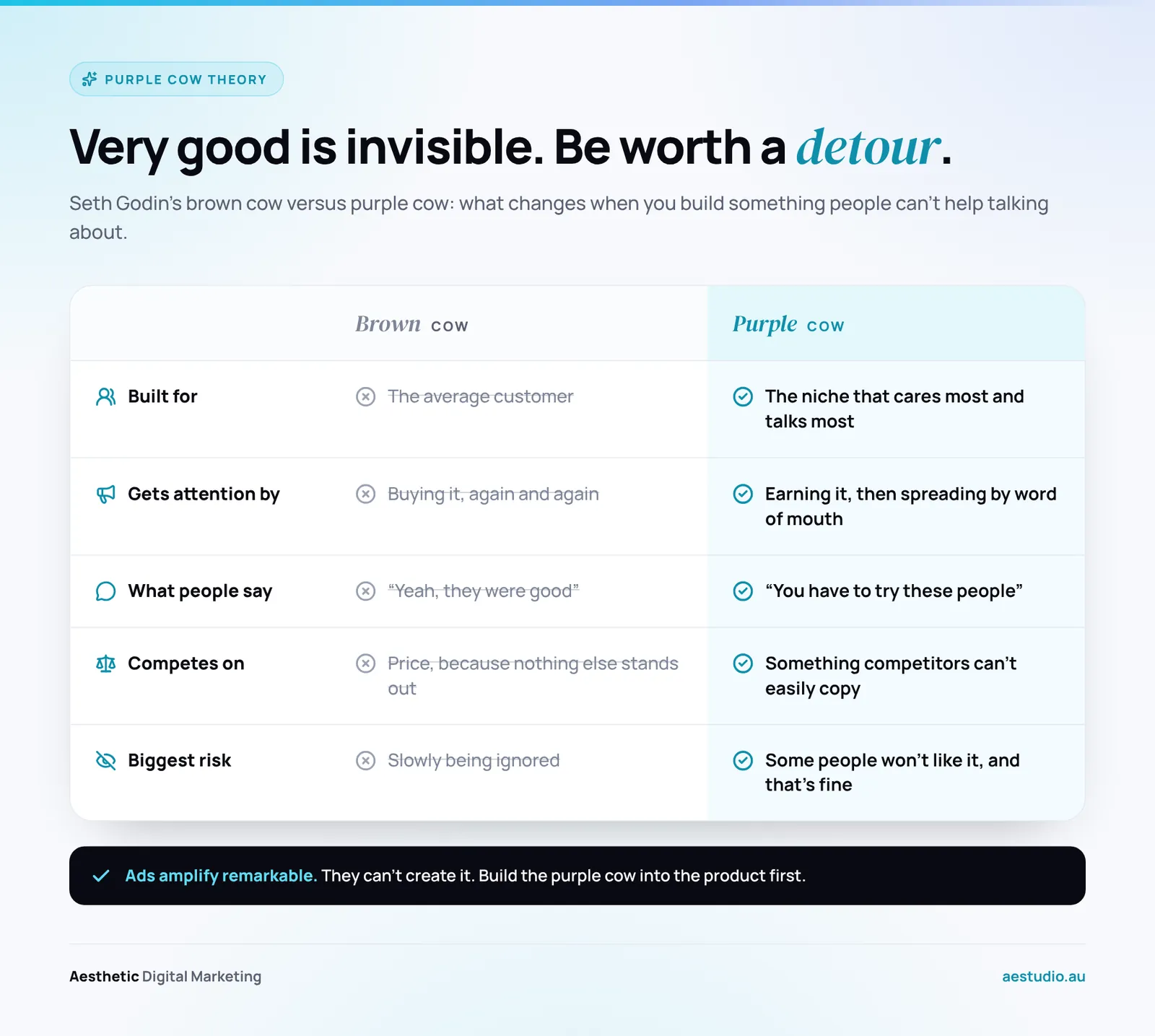
Here’s how the two approaches compare.
| Brown cow | Purple cow | |
|---|---|---|
| Built for | The average customer | The niche that cares most and talks most |
| Gets attention by | Buying it, again and again | Earning it, then spreading by word of mouth |
| What people say | “Yeah, they were good” | “You have to try these people” |
| Competes on | Price, because nothing else stands out | Something competitors can’t easily copy |
| Biggest risk | Slowly being ignored | Some people won’t like it, and that’s fine |
How to find your purple cow
Godin is better at the why than the how, so here’s the process I use with clients.
1. Listen to what customers already rave about
Read your best reviews and testimonials. Look for the thing people mention that you never thought was special. That’s often your purple cow hiding in plain sight. Those same reviews are your strongest social proof.
2. Find the edge competitors won’t go to
Every industry has a line nobody crosses: the guarantee nobody offers, the turnaround nobody promises, the niche nobody specialises in. Ask what you’d do if you weren’t scared of looking different.
3. Pick the niche that cares most
Choose the customers who feel the problem hardest and talk about it most. Remarkable is always remarkable to someone. Decide who.
4. Build it into the product, not the ad
A clever ad for an ordinary service is still an ordinary service. Put the remarkable part into what people actually experience: the offer, the delivery, the follow-up.
5. Make it easy to talk about
If your purple cow takes a paragraph to explain, nobody will repeat it. Shape it into one sentence a happy customer could say to a friend. That sentence usually becomes your unique selling proposition.
6. Milk it, then go again
Godin’s advice is to make the most of a remarkable idea while it lasts, then start working on the next one. Today’s purple cow becomes tomorrow’s industry standard once competitors catch up.

The question I ask every new client is what a happy customer would say about them to a friend. If the honest answer is “they were good”, we’ve found the real problem, and it isn’t the ads. I’d rather spend the first month finding the one thing worth repeating than six months paying to promote something people forget by Friday.
Strategy call
Find the one thing about your business worth repeating.
We’ll look at your offer, your reviews and your competitors, and help you work out what could make people talk.
Purple cow theory and paid ads
I run paid ads for a living, so here’s the honest version. Ads are an amplifier. They make a remarkable offer travel further and faster. They can’t make an ordinary offer remarkable.
When the product has a real purple cow, the ads almost write themselves. The hook is obvious, the creative is easy, and people engage because there’s something genuinely new to see.
When it doesn’t, you end up trying to fix a positioning problem with budget. That’s the pattern behind a lot of what I covered in what high-spending brands do differently with paid advertising. The brands that scale have something worth scaling.
A remarkable offer also makes winning back attention far easier, because you’ve got something worth saying in the first few words. More on that in how to win back attention in eight words.
Where purple cow theory falls short
I love this book, but it’s worth being honest about its limits.
- It suffers from survivorship bias. We hear about the purple cows that worked. Plenty of remarkable ideas flopped, and nobody wrote a book about those.
- Some markets reward reliable over remarkable. For an emergency electrician or a payroll provider, being dependable every single time can be the remarkable thing.
- Remarkable fades. Competitors copy what works. A purple cow needs regular reinvention, which takes time and money.
- It’s light on the how. The book is brilliant at diagnosing the problem and thinner on the step-by-step fix, which is why the process above matters.
None of that makes the core idea wrong. It just means purple cow theory works best alongside the other layers of marketing psychology: real brand differentiation, a clear message, and proof that backs it up. My piece on cult brand psychology shows what that looks like when it all comes together.
More from the marketing psychology series:
- Marketing psychology: 8 frameworks every marketer should study
- Cashvertising’s Life Force 8: the 8 desires behind every sale
- Cognitive biases in marketing: 8 that actually move sales
- Brand differentiation: how to stand apart when everyone sounds the same
- Unique selling proposition: how to write one that actually sells
- Cialdini’s 7 principles of persuasion, with marketing examples
- Social proof and authority: how to build trust that converts
- The StoryBrand framework: how to clarify your message
Frequently asked questions
What is purple cow theory?
Purple cow theory is Seth Godin’s idea that businesses must be remarkable to get noticed. In a world full of advertising, good but ordinary products become invisible, like brown cows in a field. Something genuinely remarkable gets talked about and spreads by word of mouth.
Who wrote Purple Cow?
Seth Godin. Purple Cow: Transform Your Business by Being Remarkable was published by Portfolio in 2003. His first self-published edition famously shipped in a milk carton.
What is an example of a purple cow?
A purple cow is anything customers can’t help mentioning. It can be quiet, like a tradie who sends a video of every finished job or an accountant who always replies the same day. What matters is that people talk about it without being asked.
Is purple cow theory still relevant?
More than ever. Feeds are more crowded and attention is more expensive than when the book came out in 2003. Being merely good gets lost faster now, while remarkable products still spread through word of mouth and shares.
What’s the difference between purple cow theory and brand differentiation?
Brand differentiation is about being meaningfully different from competitors. Purple cow theory raises the bar: the difference has to be remarkable enough that people talk about it. Every purple cow is differentiated, but not every differentiated brand is a purple cow.
The bottom line on purple cow theory
Your customers aren’t ignoring you because your work is bad. They’re ignoring you because it’s good in the same way everyone else is good.
Find the one thing worth talking about, build it into the experience, and make it easy to repeat. Then use ads to pour fuel on it. That’s how a brown cow turns purple.