
Here’s a brand differentiation test I run with almost every new client. Open your homepage and your three closest competitors’ homepages side by side. Cover the logos. Now try to tell which one is yours.
Most businesses can’t. Same stock photos, same “quality service you can trust”, same three icons for “experienced”, “reliable” and “affordable”.
That’s the problem brand differentiation solves, and it’s the fourth framework in my guide to marketing psychology frameworks every marketer should study. Below is what it actually means, where real differentiation comes from, the research debate you should know about, and how to test whether yours is working.
The short version
Swap the logo. If nobody notices, you’re not different yet.
- Differentiation is a reason to choose you. It has to be noticed by buyers and matter to them, not just exist on your capability statement.
- “Great service” isn’t a position. If a competitor could paste the claim onto their site unchanged, it doesn’t count.
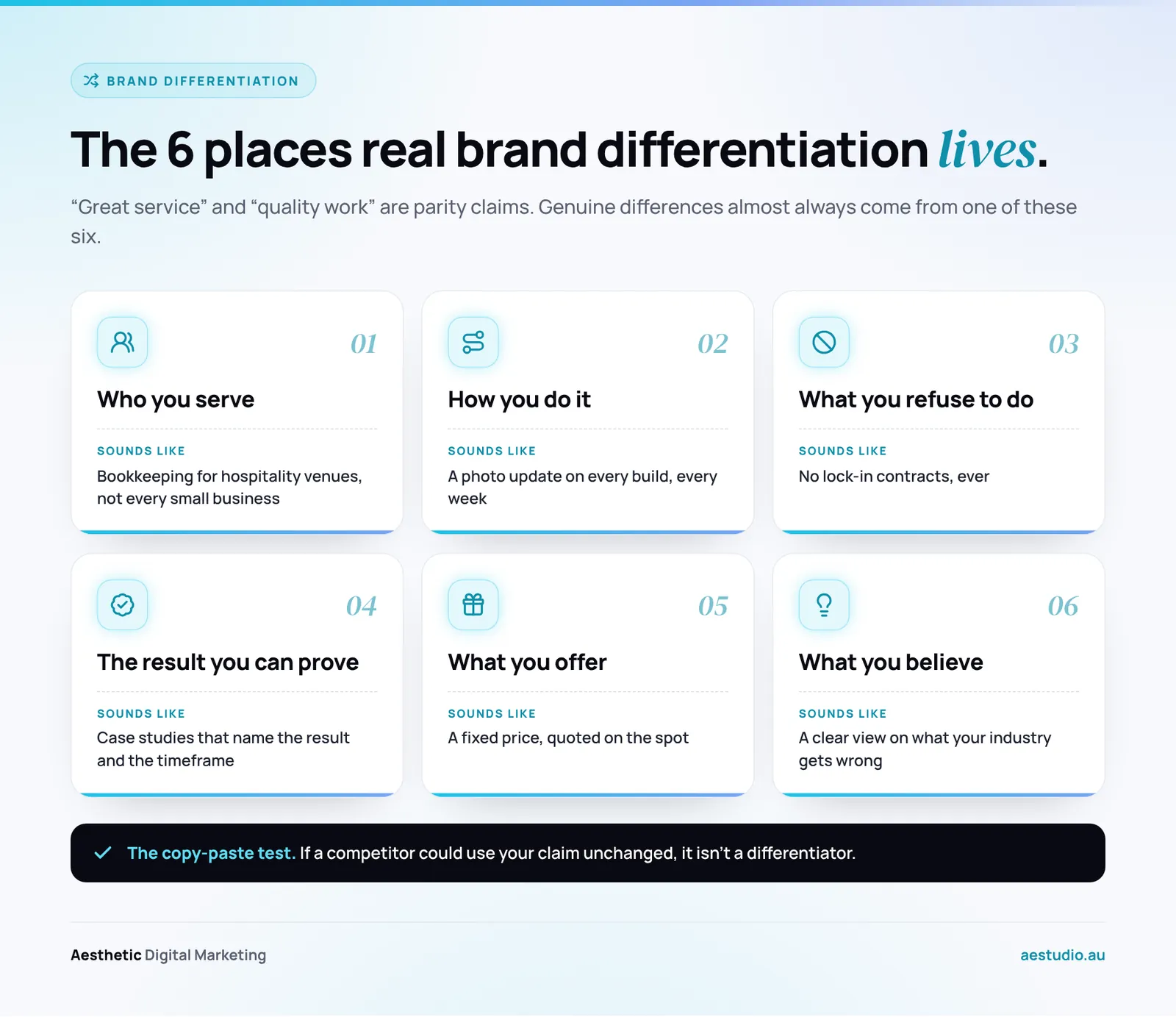
- Real differences live in six places. Who you serve, how you work, what you refuse, what you prove, what you offer and what you believe.
- Distinctiveness matters too. Research suggests being recognisable can matter as much as being different. You need both.
- Undifferentiated brands pay more for ads. When nothing stands out, you’re left competing on budget and price.
What is brand differentiation?
Brand differentiation is the reason a buyer would choose you when a similar option is one tap away. It’s the answer to “why you, not them?”
For a difference to count, it has to pass three tests:
- It’s real. You actually do it, consistently, not just on a good day.
- It’s noticed. Buyers can see it before they buy, not only after.
- It matters. It’s connected to something the buyer cares about, not something you’re proud of that they’ve never thought about.
Plenty of businesses are genuinely different behind the scenes. The trouble is their marketing describes them exactly the same way as everyone else.
The “great service” trap
These are the claims I see on almost every small business website:
- Quality workmanship
- Great customer service
- Competitive prices
- Experienced, passionate team
- Attention to detail
None of them are wrong. They’re just parity claims: things buyers already expect from anyone they’d consider. Saying them doesn’t set you apart. Failing to deliver them only knocks you out.
The simple test is the copy-paste test. If your closest competitor could lift the line onto their homepage and it would still be true, it isn’t a differentiator.
The 6 places real brand differentiation lives
After auditing a lot of homepages, I find genuine differences almost always come from one of six places. The example lines below are illustrations, not client copy.
1. Who you serve
The narrower the audience, the sharper the difference. “Bookkeeping for small businesses” is a category. “Bookkeeping for hospitality venues that never want to touch Xero” is a position.
2. How you do it
Think of a process, method or experience competitors don’t use. A builder who gives clients a weekly photo update, say, or a clinic where the same nurse sees you every time.
3. What you refuse to do
Saying no is one of the clearest signals there is. No lock-in contracts, no outsourcing, no sales calls before you’ve seen the price. A strong “we don’t” often lands harder than another “we do”.
4. The result you can prove
Specific, checkable outcomes. Case studies, before-and-afters, reviews that name the result. Proof turns a claim into a difference, which is why it pairs so closely with social proof and authority.
5. What you offer
The guarantee, the package, the pricing model, the turnaround. If the offer itself is different, you don’t have to work as hard to explain it. That’s where a sharp unique selling proposition comes from.
6. What you believe
A clear point of view about your industry. What you think everyone else gets wrong. People buy from businesses that sound like they have opinions, because opinions are hard to copy. Shared beliefs also tap into unity, the newest of Cialdini’s principles of persuasion.
Differentiation vs distinctiveness: the debate you should know about
Here’s where it gets interesting, and a little Australian. Researchers at the Ehrenberg-Bass Institute in Adelaide, led by Byron Sharp and Jenni Romaniuk, have spent years challenging the idea that brands grow by being different.
Their research suggests buyers often don’t see much difference between brands in a category, even the brands they buy. Sharp’s argument in How Brands Grow is that marketers should focus more on distinctiveness: being instantly recognisable through consistent colours, logos, characters, sounds and style.
Not everyone agrees. Critics, including Mark Ritson, argue the two ideas overlap more than the debate suggests, and that a distinctive brand still needs a reason to be chosen.
My take sits in the middle. Distinctiveness gets you remembered. Differentiation gives people a reason to pick you once they do. A small business usually needs both, and can’t afford either to be vague.
| Differentiation | Distinctiveness | |
|---|---|---|
| The question | Why should I choose you? | Do I recognise you? |
| Built from | Audience, method, offer, proof and point of view | Colours, logo, type, tone, characters and sounds |
| Shows up in | Headlines, offers, sales pages and pitches | Every ad, post, page and package, consistently |
| Fails when | The claim is generic or can’t be proven | The look changes every campaign |
| Best for | Winning the decision | Being remembered when the need arises |
If you want to strengthen the distinctiveness side, consistent brand colours are the easiest place to start.
How to test your brand differentiation
Five quick tests, roughly in the order I run them:
- The logo-swap test. Cover the logos on your homepage and three competitors’. If you can’t spot yours, buyers can’t either.
- The copy-paste test. Read your top three claims. Could a competitor use them unchanged? Cross out every one that fails.
- The “only we” sentence. Finish the sentence “We’re the only ___ that ___.” If you can’t fill it in honestly, you’ve found your next project.
- The customer question. Ask recent customers why they chose you over the alternative they almost picked. Their words are usually sharper than yours.
- The price test. If you’d lose most enquiries by charging a little more than competitors, buyers probably see you as interchangeable.
Once you’ve got a genuine difference, say it in plain words. Clever wording that nobody understands is just another way of blending in, which I cover in why unclear brands feel risky.

Most businesses I work with are more different than their websites suggest. The difference is sitting in the owner’s head, in how they handle a tricky job or the thing they refuse to cut corners on. My job is usually less about inventing a difference and more about dragging the real one out of the owner and onto the homepage.
Web design
A website that couldn’t belong to anyone else.
We build sites around what genuinely makes you different, so the right customers can see it in the first five seconds.
Brand differentiation and your ads
This is where weak differentiation gets expensive. When your ad says the same thing as every competitor’s ad, the only levers left are budget, targeting and price. You end up bidding against businesses that sound exactly like you. Smart paid advertising can’t fix that on its own.
A clear difference does the opposite. The hook is obvious, the right people self-select, and you’re not forced into a discount war to win attention.
I go deeper on the money side of this in why strong brands pay less for attention. And if you want to push past “different” into “worth talking about”, that’s exactly what purple cow theory is for.
More from the marketing psychology series:
- Marketing psychology: 8 frameworks every marketer should study
- Cashvertising’s Life Force 8: the 8 desires behind every sale
- Cognitive biases in marketing: 8 that actually move sales
- Purple cow theory: how to be worth talking about
- Unique selling proposition: how to write one that actually sells
- Cialdini’s 7 principles of persuasion, with marketing examples
- Social proof and authority: how to build trust that converts
- The StoryBrand framework: how to clarify your message
Frequently asked questions
What is brand differentiation?
Brand differentiation is what makes a buyer choose you over a similar competitor. To count, the difference must be real, visible before purchase and important to the customer. It usually comes from who you serve, how you work, what you offer or what you can prove.
What are examples of brand differentiation?
Serving a specific niche, offering a guarantee competitors won’t, using a distinctive process, refusing common industry practices like lock-in contracts, or proving results with detailed case studies. Generic claims like great service or quality work are not differentiation.
What’s the difference between differentiation and distinctiveness?
Differentiation gives people a reason to choose you. Distinctiveness makes you instantly recognisable through consistent colours, logos and style. Research from the Ehrenberg-Bass Institute argues distinctiveness is undervalued. Most small businesses need both.
How do I know if my brand is differentiated?
Cover the logos on your homepage and your competitors’ homepages. If you can’t tell which is yours, buyers can’t either. Also check whether competitors could copy your main claims unchanged, and ask customers why they chose you over the alternative.
Is brand differentiation the same as a USP?
Not quite. Brand differentiation is the bigger picture of how you’re different across your audience, approach and beliefs. A unique selling proposition is one specific, provable promise drawn from that, short enough to lead a headline or an ad.
The bottom line on brand differentiation
Being good isn’t a difference. It’s the entry ticket.
Find the real difference that’s already there, prove it, say it plainly and repeat it in a look people recognise. Do that and you stop competing on price, because buyers finally have a reason to pick you.