

Cialdini’s principles of persuasion are probably the most quoted ideas in marketing. Reciprocity, scarcity, social proof: you’ve almost certainly heard the words. Far fewer businesses actually use them on purpose.
Most landing pages I review lean on two or three principles by accident and miss the rest entirely. The best ones use five or six, and they never feel pushy.
This is the sixth framework in my guide to marketing psychology frameworks every marketer should study. Below are all seven principles, the research behind each, how they show up in real marketing, and where persuasion tips over into manipulation.
The short version
When people aren’t sure, they look for cues. Give them honest ones.
- Seven principles, one idea. Reciprocity, commitment, social proof, authority, liking, scarcity and unity are shortcuts people use when deciding is hard.
- Give before you ask. A genuinely useful free resource creates goodwill that a hard sell never will.
- Small yeses lead to big ones. A quiz, a short form or a free consult makes the next step feel natural.
- Unity is the newest and most underused. People say yes to those they see as part of their own group.
- Every principle needs to be true. Fake scarcity and fake reviews aren’t persuasion. They’re misleading, and they can breach Australian Consumer Law.
What are Cialdini’s principles of persuasion?
Robert Cialdini is a psychologist who spent years studying why people say yes. Part of that research involved going undercover in sales training programmes, from car dealerships to fundraising teams, to see which techniques consistently worked.
He published the results in Influence: The Psychology of Persuasion, first released in 1984. It named six principles. Decades later, in his 2016 book Pre-Suasion, he added a seventh: unity.
The principles aren’t tricks. They’re the mental shortcuts people use when a decision is too uncertain, too complex or too low-stakes to think through properly. They overlap heavily with the research on cognitive biases in marketing, packaged specifically for selling.
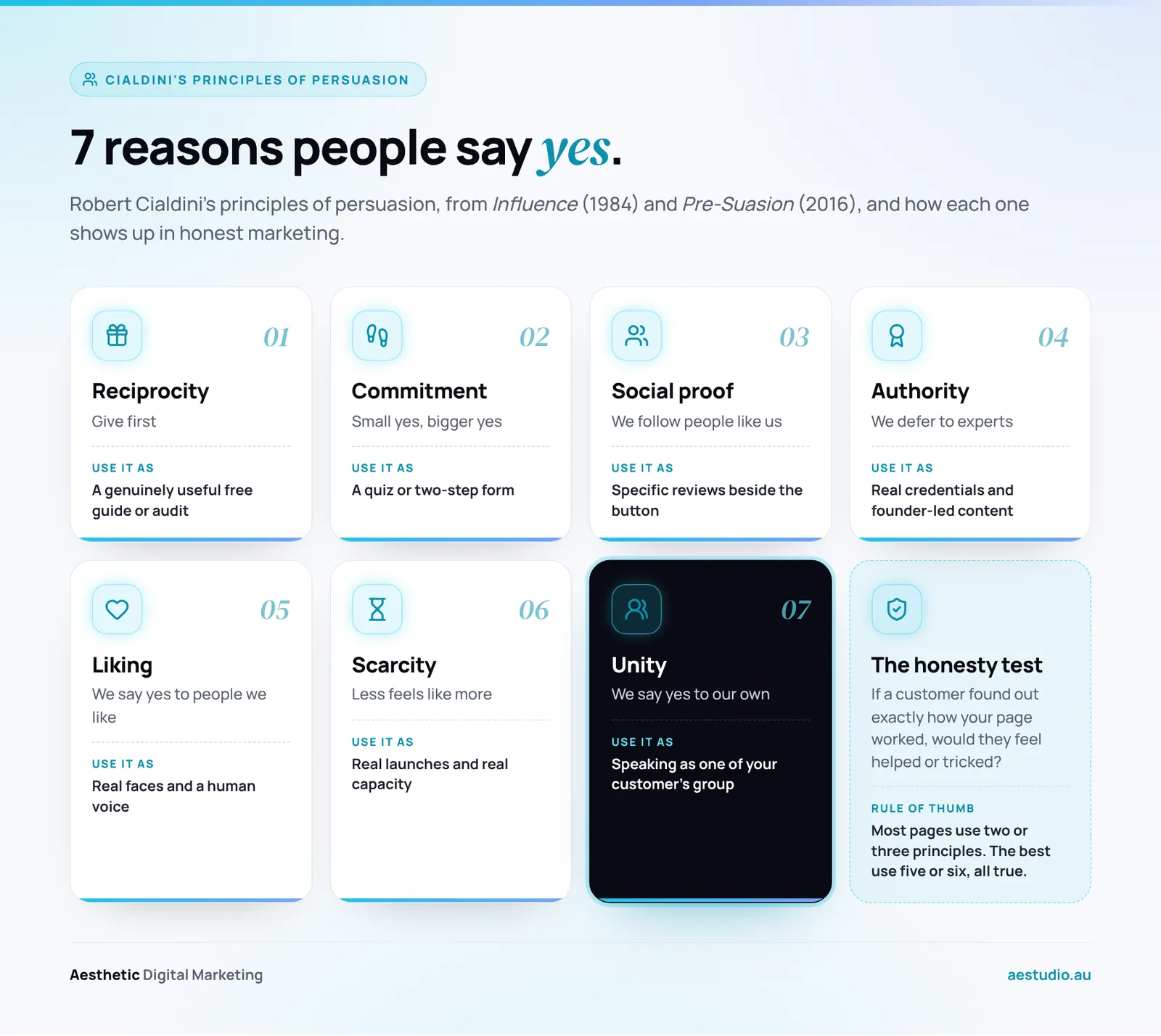
1. Reciprocity: give first
When someone does something for us, we feel a pull to return the favour. It’s one of the strongest social norms there is.
A well-known restaurant study by Strohmetz and colleagues found diners who received a small piece of candy with their bill tipped more than diners who received none. The way the candy was offered mattered too: a more personal gesture lifted tips further.
In marketing: free guides, audits, templates, calculators and genuinely useful emails. Our own free ebook on hiring a web design agency and ROAS calculator exist for exactly this reason. A good email marketing sequence runs on reciprocity, giving value for weeks before asking for anything.
Watch out: the gift has to be useful on its own. A “free guide” that’s really a sales brochure creates the opposite of goodwill.
2. Commitment and consistency: small yes, bigger yes
Once people take a small step, they like to stay consistent with it. This is the classic foot-in-the-door effect: agree to something small and you’re more likely to agree to something bigger later.
In marketing: quizzes, multi-step forms that start with an easy question, free consultations, saved carts and “pick your goal” style onboarding. Each small action makes the next one feel like a natural continuation rather than a new decision.
Watch out: don’t trap people. A small yes should lead somewhere they actually want to go, not into a subscription they can’t find the cancel button for.
3. Social proof: we follow people like us
When we’re unsure, we look at what other people are doing, especially people similar to us. Reviews, testimonials, customer counts and “most popular” labels all work on this principle.
In marketing: reviews beside the price, case studies beside the call to action, real customer content in ads. The more similar the person in the proof is to your buyer, the harder it works.
Social proof is big enough to deserve its own article, so I’ve written one: social proof and authority, and how to build trust that converts.
4. Authority: we defer to experts
People are more likely to follow advice from someone who’s credible and knowledgeable. Uniforms, qualifications, titles and published expertise all signal authority.
In marketing: credentials, years of genuine specialisation, media features, industry partnerships, and founder-led content that shows you know your stuff. Detailed, specific content beats vague claims of being “experts”, which every competitor already says.
Watch out: authority has to be real. Borrowed badges, implied endorsements and inflated titles are misleading. Some industries have extra rules too. Registered health practitioners, for example, face strict limits on how they can advertise.
5. Liking: we say yes to people we like
We’re more easily persuaded by people we like. Cialdini found liking grows from similarity, genuine compliments, cooperation and familiarity.
In marketing: real team photos instead of stock, founder-led videos, a brand voice that sounds like a person, and content that shares your audience’s frustrations. This is why authenticity is becoming more valuable as AI-generated content floods every feed.
Watch out: liking can’t be faked for long. A friendly ad followed by a cold, slow sales process undoes it instantly.
6. Scarcity: less feels like more
Opportunities feel more valuable when they’re limited, whether by time, quantity or access. Scarcity also links closely to loss aversion, one of the strongest cognitive biases there is.
In marketing: genuine launch windows, limited stock, booking calendars with real capacity, seasonal offers with a real end date.
Watch out: fake countdown timers that reset on refresh and “only 2 left” messages that never change. They’re easy to spot, they wreck trust, and false urgency can breach Australian Consumer Law.
7. Unity: we say yes to our own
Unity is the principle Cialdini added in 2016, and it goes deeper than liking. It’s about shared identity: people treat those they see as part of “us” differently from everyone else, whether that’s family, a profession, a hometown or a community.
In marketing: speaking as a member of your customer’s group rather than a supplier to it. Local businesses can lean into their community. Niche brands can talk like insiders. Brands with a strong point of view create a group people want to belong to, which is the engine behind cult brand psychology.
Watch out: you can’t claim a group you’re not part of. Borrowed identity feels hollow, and audiences notice quickly.
Cialdini’s principles of persuasion at a glance
| Principle | Use it as | The line not to cross |
|---|---|---|
| Reciprocity | Free guides, audits, calculators and useful emails | “Free” content that’s really a sales pitch |
| Commitment | Quizzes, multi-step forms and free consults | Hidden subscriptions and hard-to-cancel plans |
| Social proof | Specific reviews, case studies and customer content | Fake, edited or cherry-picked reviews |
| Authority | Real credentials, expertise and founder-led content | Borrowed badges and inflated titles |
| Liking | Real faces, a human voice and shared frustrations | A friendly ad followed by a cold sales process |
| Scarcity | Real launches, stock limits and capacity | Countdown timers that reset on refresh |
| Unity | Speaking as one of your customer’s group | Claiming an identity you don’t share |
How to audit a landing page against Cialdini’s principles
This is the exercise I run when a landing page gets traffic but not enquiries. It takes about twenty minutes.
- Print the page. Or screenshot it top to bottom. Seeing it all at once matters.
- Write the seven principles down the side. Next to each, note where the page uses it, if at all.
- Count the gaps. Most pages use social proof and maybe authority. Reciprocity, commitment and unity are usually missing.
- Fill the easiest gap first. A free resource, a two-step form or a review beside the button can often be added in an afternoon.
- Test the change. Run the new version against the old one so you know what actually moved the numbers. That habit is the heart of conversion rate optimisation.
Pair this with the structure in five homepage secrets that increase conversions and you’ll have covered most of what makes a page persuasive.

The principle small businesses skip most is reciprocity. They want the enquiry before they’ve given anything. Yet the businesses with the warmest leads I see are usually the ones teaching for free: answering questions in their content, sharing a useful checklist, explaining the price before anyone asks. By the time the customer reaches out, the trust is already built.
Landing page design
Landing pages that make saying yes feel easy.
We design landing pages around how people actually decide, with honest proof, clear offers and fewer reasons to hesitate.
Where Cialdini’s principles of persuasion go wrong
Cialdini himself has always drawn a line between persuasion and manipulation. The principles work because they’re usually reliable shortcuts. Faking them breaks that trust, and buyers are getting better at spotting it.
- Fake scarcity, like resetting timers and endless “final days” sales.
- Fake social proof, like invented reviews, paid reviews without disclosure, or deleting the negative ones. The ACCC treats all of these as misleading.
- Fake authority, like badges for awards you didn’t win or “as seen in” logos for a single paid listing.
- Forced commitment, like pre-ticked boxes and cancellation mazes.
The test is simple. If the customer later found out exactly how the page worked, would they feel helped or tricked? Persuasion should survive that question.
More from the marketing psychology series:
- Marketing psychology: 8 frameworks every marketer should study
- Cashvertising’s Life Force 8: the 8 desires behind every sale
- Cognitive biases in marketing: 8 that actually move sales
- Purple cow theory: how to be worth talking about
- Brand differentiation: how to stand apart when everyone sounds the same
- Unique selling proposition: how to write one that actually sells
- Social proof and authority: how to build trust that converts
- The StoryBrand framework: how to clarify your message
Frequently asked questions
What are Cialdini’s 7 principles of persuasion?
Reciprocity, commitment and consistency, social proof, authority, liking, scarcity and unity. Robert Cialdini set out the first six in Influence in 1984 and added unity in his 2016 book Pre-Suasion.
What is the most powerful principle of persuasion?
It depends on the situation. Social proof is strongest when people are uncertain, authority when the decision needs expertise, and scarcity when timing matters. The most persuasive pages combine several principles rather than relying on one.
What is the unity principle?
Unity is the idea that people are more easily persuaded by those they see as part of their own group, such as family, community, profession or shared beliefs. It’s about shared identity, which runs deeper than simply liking someone.
Is using Cialdini’s principles manipulative?
Not when they’re used honestly. Real reviews, genuine scarcity and useful free resources help people decide. Fake versions of any principle are manipulation, and misleading claims can breach Australian Consumer Law.
How do I use Cialdini’s principles on my website?
Offer a genuinely useful free resource, start forms with an easy first step, place specific reviews near your call to action, show real credentials and real faces, keep any scarcity genuine, and speak to your audience as one of them.
The bottom line on Cialdini’s principles of persuasion
People don’t weigh every decision from scratch. They look for cues: what others are doing, who’s an expert, what’s running out, who’s one of them.
Give them honest cues. Give first, ask small, prove it, show who you are and keep it real. That’s not manipulation. It’s making a good decision easier to make.