The most famous unique selling proposition ever written is about chocolate. M&M’s melt in your mouth, not in your hand. One specific benefit, something rival chocolates couldn’t claim, and you could prove it by holding one.
That line is credited to adman Rosser Reeves, the person who coined the idea of the USP in the first place. And it still beats most small business taglines I read today.
This is the fifth framework in my guide to marketing psychology frameworks every marketer should study. Here’s what a USP actually is, what it isn’t, a step-by-step way to write yours, and where it needs to show up once you’ve got it.
The short version
A USP isn’t a slogan. It’s a promise you can prove.
- Three parts, all required. A specific benefit, one competitors don’t or can’t offer, strong enough to pull new customers in.
- One promise, not a list. If it takes a paragraph to explain, it isn’t a USP yet.
- Specific beats impressive. A real number, timeframe or guarantee lands harder than “the best” ever will.
- Proof makes it believable. A guarantee, a demonstration or a case study turns a claim into a reason to buy.
- Use it everywhere. Your hero headline, your ad hooks, your Google Business Profile and your sales calls should all say the same thing.
What is a unique selling proposition?
A unique selling proposition (USP) is the one specific, provable reason a customer should choose you over the alternatives.
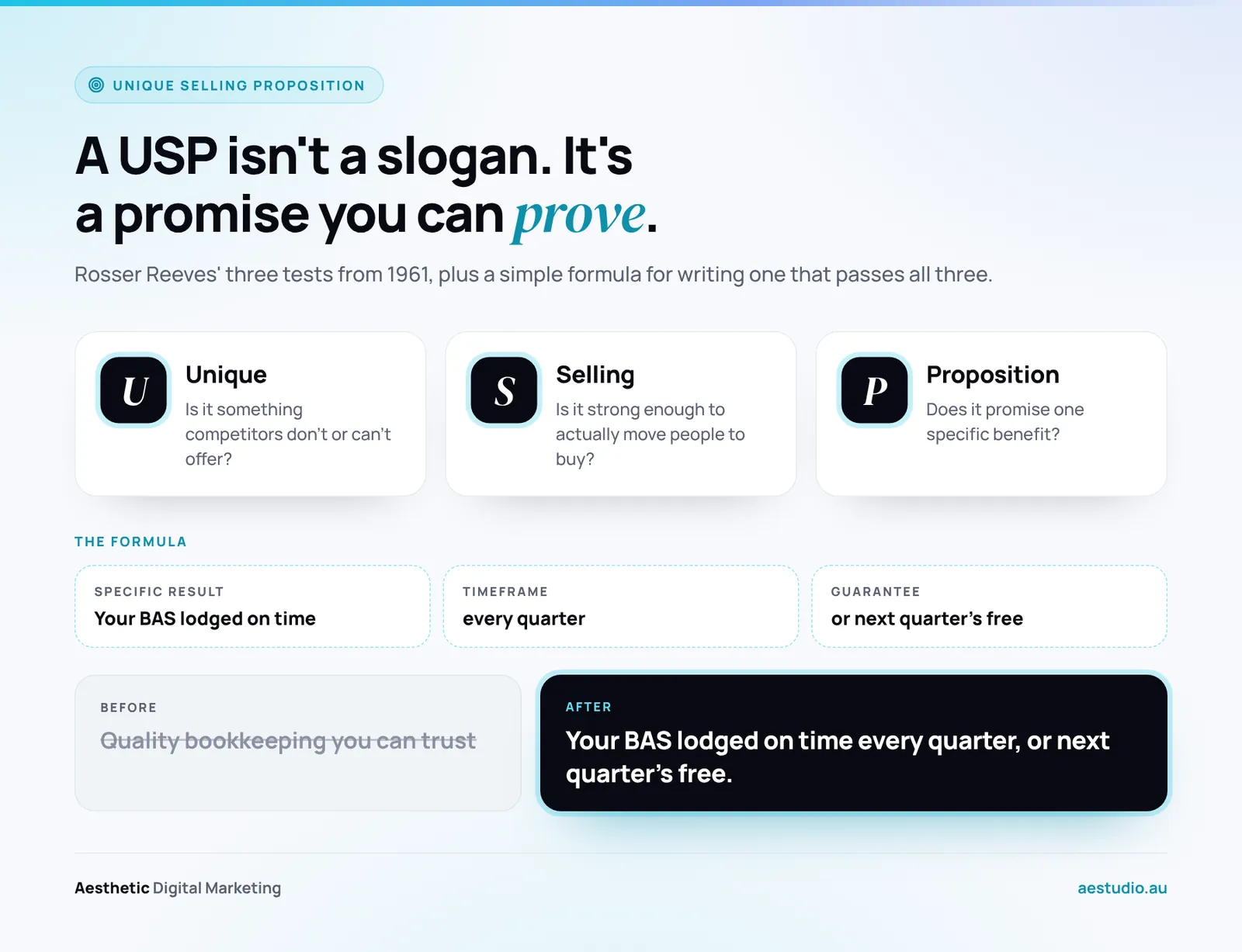
The idea comes from Rosser Reeves, the creative partner and later chairman of the Ted Bates advertising agency. He set it out in his 1961 book Reality in Advertising, and his definition had three strict parts:
- Proposition. Every ad must say to the buyer: buy this, and you’ll get this specific benefit.
- Unique. The benefit must be one competitors don’t offer, or don’t claim.
- Selling. It must be strong enough to actually move people to buy, not just sound clever.
Miss any one of the three and you don’t have a USP. You have a tagline.
What a USP is not
Most “USPs” I see on small business websites fall into one of these traps:
- A slogan. “Excellence in every detail” sounds nice and promises nothing.
- A mission statement. What you aspire to isn’t what the customer gets.
- A feature list. Five benefits in a row means none of them stick.
- A superlative. “The best” and “number one” can’t be proven, and buyers tune them out.
- A parity claim. Quality, service and value are expected from everyone, so they don’t count as unique.
Unique selling proposition examples
Two classics from Reeves’ era show the formula at its simplest:
- M&M’s: melts in your mouth, not in your hand. A specific benefit, easy to demonstrate, and something other chocolates couldn’t say.
- Anacin: Reeves’ Ted Bates agency ran Anacin TV ads promising fast pain relief for decades. Repetitive, yes, but relentlessly clear about one benefit.
And here’s how it translates to small businesses. These are illustrations, not client copy:
- An electrician: “On time, or the call-out fee is on us.”
- A bookkeeper: “Your BAS lodged on time every quarter, or next quarter’s free.”
- A cosmetic clinic: “The same nurse at every appointment, from consult to review.”
- A web designer: “Your new site live in 21 days, or you don’t pay the final invoice.”
Notice the pattern. Each one is specific, provable and hard for a competitor to copy without actually changing how they work.
How to write your unique selling proposition
This is the process I use with clients. It usually takes one honest workshop, not a rebrand.
1. Start from what genuinely makes you different
A USP is the sharpest line drawn from your wider brand differentiation. If you haven’t worked out where you’re genuinely different, do that first. You can’t write a unique promise about a business that isn’t unique yet. If you want to go further than different, aim for a purple cow.
2. Pick one benefit
Choose the single benefit your best customers care about most. Not three. One. Your reviews are the best place to look, because customers tell you exactly what they valued. The strongest benefits usually trace back to one of the Life Force 8 desires.
3. Make it specific
Swap vague words for concrete ones. “Fast” becomes “within 24 hours”. “Affordable” becomes “fixed price, quoted upfront”. Specifics are believable because they can be checked. That’s framing working in your favour.
4. Back it with proof or a guarantee
The strongest USPs carry their own proof: a guarantee, a demonstration or a track record. Taking the risk off the buyer is what Sabri Suby calls a Godfather offer, which I unpack in my Sell Like Crazy review. Alex Hormozi’s value equation is another great lens for this, covered in my $100M Offers review.
5. Cut it to one sentence
Aim for something a happy customer could repeat to a friend. If it won’t fit in a headline, keep cutting.
6. Test it in the market
Run two or three versions as ad hooks and see which one people respond to. Your audience will often pick a different winner than you would, which is exactly why A/B testing your ads is worth the effort.
Two simple templates to get you started:
- We help [who] get [specific result] in [timeframe], or [guarantee].
- The only [category] in [place or niche] that [genuine difference].
| Weak USP | Strong USP | |
|---|---|---|
| Example | “Quality bookkeeping you can trust” | “Your BAS lodged on time every quarter, or next quarter’s free” |
| Benefit | Vague (“quality”) | Specific (on time, every quarter) |
| Proof | None | A guarantee that takes the risk away |
| Could a competitor say it? | Yes, and most already do | Only if they’re willing to back it |
| Works as an ad hook? | Scrolled past | Stops the right people |
The moment owners get nervous in a USP workshop is when we add the guarantee. That nervousness is useful. If you wouldn’t back the promise, buyers can sense it, and it isn’t really your USP. If you would, you’ve just found the line that does more selling than any ad budget.
Meta ads
Put your USP in front of the people who need it.
We turn your sharpest promise into ad hooks, test them against each other and scale the one your buyers respond to.
Where your unique selling proposition should show up
A USP that lives in a strategy document does nothing. Once you’ve got it, put it everywhere a buyer makes a decision:
- Your homepage hero. The first line visitors read. My guide to high-converting headlines shows how to shape it.
- Your ad hooks. The first line of a Meta ad and the first three seconds of a video. More in Facebook ad copy best practices.
- Your Google ads. At least one search ad headline should carry the promise, word for word.
- Your Google Business Profile. The description is prime real estate most businesses waste.
- Your quotes and proposals. Put the promise on the page right above the price.
- Your sales calls. Everyone who answers the phone should be able to say it the same way.
Consistency is the point. Buyers need to hear the same promise several times before it sticks.
USP vs value proposition vs positioning
These three get mixed up constantly, so here’s the plain-English version:
- Positioning is where you sit in the buyer’s mind compared with competitors. It’s the strategy.
- Value proposition is the full case for why you’re worth buying: all the benefits, outcomes and reasons together.
- Unique selling proposition is the single sharpest, most provable promise pulled from that case. It’s the line you lead with.
Get your positioning right, build your value proposition around it, then distil it into one USP you can repeat everywhere.
More from the marketing psychology series:
- Marketing psychology: 8 frameworks every marketer should study
- Cashvertising’s Life Force 8: the 8 desires behind every sale
- Cognitive biases in marketing: 8 that actually move sales
- Purple cow theory: how to be worth talking about
- Brand differentiation: how to stand apart when everyone sounds the same
- Cialdini’s 7 principles of persuasion, with marketing examples
- Social proof and authority: how to build trust that converts
- The StoryBrand framework: how to clarify your message
Frequently asked questions
What is a unique selling proposition?
A unique selling proposition is the single specific, provable reason a customer should choose you over competitors. The idea comes from adman Rosser Reeves, who said it needs a specific benefit, one competitors don’t offer, and enough pull to win new customers.
What is an example of a unique selling proposition?
The classic is M&M’s: melts in your mouth, not in your hand. For a small business it might be a bookkeeper promising your BAS lodged on time every quarter or next quarter is free. Both are specific, provable and hard for a competitor to copy.
How do I write a unique selling proposition?
Start from what genuinely makes you different, pick the one benefit your best customers value most, make it specific, back it with proof or a guarantee, cut it to one sentence, then test a few versions as ad hooks to see which one people respond to.
What’s the difference between a USP and a value proposition?
A value proposition is the full case for buying from you, covering all your benefits. A USP is the single sharpest, most provable promise pulled from that case, short enough to lead a headline or an ad.
Does every business need a USP?
Yes. Without one, buyers compare you on price because they can’t see another difference. Even in crowded industries, a specific promise about speed, reliability, a niche or a guarantee gives people a reason to choose you.
The bottom line on your unique selling proposition
A USP isn’t a clever line. It’s one promise, specific enough to check and strong enough to back with your own money.
Write it, prove it, then repeat it everywhere a buyer is deciding. Rosser Reeves sold chocolate with eight words. You can sell whatever you do with one sentence.